
History Come Alive: Mit’hat Frashëri’s Unforgettable Description of Vlora in 1912 and 1920
Updated: Apr 9
Author: Enri Lala

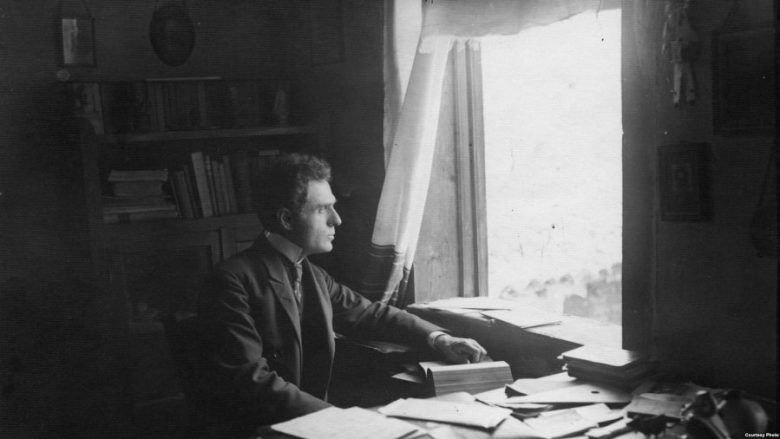
One of the factors which lends Mit’hat Frashëri, viewed as the founder of modern Albanian nationalism, a special role in history is his presence – and at times protagonism – at several pivotal chapters of the twentieth century. This à la Forrest Gump quality, viciously suppressed from public memory by the Communists, has come back into flourishing by newly published documents and public discussion. While traditional Albanian scholars have contributed to this effort in part, efforts by younger independent authors have been particularly refreshing.
The following letter captures his ability to uniquely describe the events which set Albanian society on its path. It was penned in October 1922 and describes Frashëri’s trip from the Italian port town of Trieste to Vlora. He was fresh off his duties chairing the Albanian delegation to the Paris Peace Conference, which would prove crucial in securing the territorial integrity of the borders the new state had been granted in the 1913 London Conference of Ambassadors. He had not yet taken up his role as ambassador to Greece, which would commence early the following year. As such, we can imagine him drafting this in a period of relative leisure, which fits well with the tone of his writing.
Frashëri refers to two events throughout the letter: Twelve and Twenty. Twelve is the 1912 Albanian Declaration of Independence from the Ottoman Empire, led by Ismail Qemali and signed by forty notables, in the city of Vlora. Twenty is the lesser-known Vlora War of 1920, in which Albanian forces succeeded in forcing the post-World War I Italian state, roiled by its own domestic troubles, to pull its forces out of Vlora and abandon its claims to a mandate on the Albanian mainland, which it was granted under the secret London Treaty of 1915.
Frashëri gives eloquent voice to the prevalent view that this scrappy resistance and the ensuing partial diplomatic victory gave the fledgling Albanian state an organizing aim and the taste of tangible victory after a post-Independence decade spent somewhere between confusion, powerlessness and humiliation.
These are clearly not the ruminations of a tourist to a strange and exciting city. Frasheri served as Minister of Public Works in the first post-Independence government and led the Albanian delegation to Paris – against whose backdrop the conflict in 1920 was being pursued. Accordingly, the tone of the letter rings more like that of someone revisiting an old friend to whom they owe a deep spiritual, rather than material, gratitude. It is a rare description of Albanian society at the end of an exhausting decade, yet rooted in a quiet, determined belief in the promise of what lay ahead.
Vlora, a name henceforth tied with the name of Albania. Two dates: 1912 and 1920, two events, two flames. The latter completed the former, fortified it, gave it luster, made it true and tangible, rescued it from the fog and doubt.
The former paved the way for the latter, which gave it form and soul, made it visible and live. It gathered in this cradle the zeitgeist which had spread about, making its way through the air without planting its feet on the soil; it placed it determinedly in this expanse of sand and then spread it to all of Albania, as the dew which falls and revives the plant withered from drought.
Often the fate of an individual or a nation depends on the unexpected and we search in vain for the causes of events, probing how and why this came to be. These are events that flow without forewarning, rooted in imperceptible factors.
Yet others are the direct fruit of a desire and will which makes them happen by putting thought and care into them. We have already concluded that fate is blind. In these latter conditions, fate takes off the veil which blocks its eyes and sees, observes, understands.
Twelve could very well have happened elsewhere instead of Vlora, be it in the most proximate or distant city or village. But Twenty could not have happened anywhere but Vlora, in this soil, by these people.
Twelve sparked a flame by materializing the desire and ideal of a nation, completing an idea and shaping the mind. Twenty gave life to the matter, spirit to the form, captured hearts and minds. The conclusion of Twelve came somewhat suddenly, unexpectedly, perhaps a little prematurely.
And in the euphoria and haze of a joyous occasion, which comes expectedly, the national consciousness did not enjoy the time to crystallize its aspirations, to grasp the dimensions of its fate, to take in and relish its new jubilation. It was an idea, an ideal, a desire which lingered a while in the air, without making its way down to earth.
The interval between Twelve and Twenty is filled with dark and evil – but perhaps not illogical – deeds. Logic is merciless, even more so when it looks back on work that has already been done, on events whose driving forces we now recognize. And so, in eight years rife with miseries, if this life from its dawn to end recognizes miseries, we find an explanation.
Yet explaining, be it through logic, cannot save man from misfortune and cannot undo for him neither sorrow nor shame. Explanations do not amount to forgiveness, they do not rid one of blame. Commenting on past events does not go hand-in-hand with forgetting, but it may jolt one awake, because if he can identify the sources of an event (and we generally perceive unfortunate events as blameworthy and shameful), he also discerns the means and methods by which the negative situation took form, and learns how to reverse it, and thus bring about a brighter path.
Cold-bloodedness in weighing and judging matters is a simple joy, yet at the same time a misfortune. It rejoices the soul but saddens the heart. Either way, it grants one peace, and whoever enjoys this knows to wait, to remain patient and keep alive the hope that his work will prove to be the final judgement.
In the interplay of hurdles, difficulties and dark deeds, man sees that work and the positive act can nullify the negative or unfortunate one. Work and activity fuel hope. As the mechanic who knows the vehicle well and restores it, no matter how irreparable it appears, he who analyzes, who embraces the endless circuits of this grand vehicle we call life, recognizes that through patient and tireless work, the system can be set into motion in the desired direction.
There needs to be an initiator who wishes to restore the vehicle, and Vlora rose to this role. It became not an initiator randomly chosen by fate, but a wise one, conscious of what it sought to accomplish, creating the conditions, sharpening it will, through quiet patience, determined to either emerge triumphant or perish; aware of every risk, it weighed every “how” and “why” and the odds – in cold blood it entered the flames and came out with victory in its hands.
Often a small act, a minor spark, gives fruit to something significant. Here we are speaking of a momentous act, a consequential spark, which births something grand. Thus, Twenty crowns Twelve. Twenty the mighty, more bold than established in its power, saves Twelve from the thorns and ravines, helps it rise to its feet and commands it: march!
Twelve brought this Vlora fame. Twenty brought it honor – and Vlora honored it in turn. Twenty told Albania: you are free and you owe this liberty only to yourself. You do not have friends and benefactors, but you have yourself. And when you have yourself, there is no place for fear. It was impossible for man not to follow this direction; Albania regained its footing, its strength and pressed forward. Its power, vitality, soul and zeal emerged from its own will.
Honor, respect and veneration for this land! A desire of ten full years was pushing the nation towards a new future, towards a life made and destined for the common good and benefit, for the interest and distinction of the country. A light was shone upon the path we were undertaking and it set out a new direction. The lantern was lit and the compass of the will had found a pole – at times dim, often at risk of being extinguished. The compass would lose its pole and the traveler was left to pursue the route as if the ship without a rudder or the boat without sails. Black clouds began to shroud the glow of the star which guided the way and the restless surge of the waves grew threatening.
That lantern required new oil to shine, for its glow to rise above the smoke and light the path forward. And if sweat turns all fruitful, here the sweat was subsumed in blood and only revived through will. Veneration, respect and honor for those who made this happen!
***
In this city, now made truly “Albanian,” every Albanian walks with his head high and feels a deep sense of pride, searching for new merits worthy of praise, and in every beat of the heart, makes a prayer to find this city more admirable and blossoming than any other.
To what end would that self-sacrifice, that valor of days past, have gone if it were not completed by tireless work which adds to it new luster every passing day. And with this desire in my heart, I rush to make a brief visit. Eight years of turbulence have done only limited honors to the physiognomy of the city.: here and there one spots a few new homes, some modernized shops, a developed market square, well-maintained government buildings and a care shown by the municipality towards maintaining the cleanliness of the streets and reconstructing destroyed buildings.
I learn that a city garden, a small park is being prepared in this soft clime, here where the olive lives, the lemon and orange flourish, where the eucalyptus, cactus and palm tree, with all their companions from more intense climates, find a protective sun and fertile vegetation. There is no doubt that a well-kept park could become a model for greenery and a delight for the eye and the soul alike. But why would we preempt it, let us await its completion.
The essence lies not in saying but in doing. Here stands the hospital: the doctor shows me the way, welcoming me in as the head of a household does, takes me to the ill, to the operation rooms, to the stocks of medicine and to the pharmacy. In each of these reigns a cleanliness and solicitude; throughout one can see the manifestation of a love for mastery, a wish to serve.
I learn that there is talk of establishing a museum and last night an amateur troupe played a theater piece. A museum! If they prove willing, how plentiful the materials we could put together. If only we nurtured a love of the past and felt a little more deeply for the inheritance of our forefathers!
Yet we do not need to trace back to our distant ancestors, or head to the “antiques” of Pojan and so many other regions, the soil of which covers ancient cities. If we were to collect the memories and relics of these last ten years alone – if taking care that the years 1912 and1920 are not condemned to oblivion were the only mission of the museum of Vlora, this would be among the most valuable collections for us. Strolling, I reflect.
Ten years. The memory is yet too fresh to be forgotten. How much has changed from then to now: at that time, the populace showed a disinterest in all that shaped social affairs. Now all that has to do with Albania awakens its interest. The election of members of parliament and municipal races alike are undertaken with a zeal which demonstrates that civic duties are well-understood.
National consciousness, when awakened, lends man a certain nobility, as does every passion and strong current which dignifies the affairs of us mortals. But nobility also comes with weighty responsibilities. It is rare and rather grand to be noble, but how momentous a task it is to live up to that standard. How heavy a burden falls upon the shoulders of this Vlora, from which all expect the realization of major works, beautification and flourishing!
The awakening of the national sentiment inspires enthusiasm and this impetus which emerges from the heart drives man to advance, to achieve new heights and show no respite until he has reached the summit of the path taken up. Twelve did not awaken such enthusiasm, it did not one's blood racing, nor discard this mortal atmosphere, which resembled that enveloping the man condemned for destruction. And it remained in hearts and souls like the slumber of the sleepwalker. Twenty could do nothing but awaken that enthusiasm.
No, an aim such as this could not fail to recognize the duties that fell on its shoulders. The frustration of those hopes awakened by Twelve would amount to the greatest sin in the world.
Vlora, which took this grand and excellent a step, cannot sink into the dark. How many more works yet to complete! How many more steps yet to take!
October 12, 1922
Enri Lala is the founder and Chief Editor of Arbanon Magazine. He is a fourth-year History and Global Studies Major and French Minor at the University of California, Santa Barbara. He is interested in various themes in Albanian and European history, international politics and literature.


Comments