
“We won’t give up our land, it is tied to our soul” - How Much Luxury Tourism Does Albania Really Need?
Article by Eleftheria Kousta

It was a rainy November day in 2019 and I found myself in the Southern Albanian coastal village of Qeparo in Himara municipality. Seen at the time as a destination off the regular global tourist beaten path, Albania was starting to see its first modest surge of foreign tourists eager to explore what they perceived as an unspoiled land.
On my single day there, I came across an old resident. She was foreign-educated, and could easily hold her own in a wide range of conversations. It was this articulate quality which distinguished her vision of the future, which was otherwise similar to many of her peers in its pessimism. Yet you could find evidence for her prediction wherever you looked. “They are destroying places that have withstood upheaval and hardship. Places which are important for our culture and identity. Things will get worse,” she told me at the time.
Seven years later, her words ring with an ominous prescience.
Jared Kushner, the American real estate mogul and son-in-law of US President Donald Trump has been at the center of plans for a $1.4 billion luxury resort in the Vjosa-Narta Protected Landscape and Sazan island in the bay of Vlora. Though first announced in March 2024, fierce and widespread public opposition began early this summer. Initial protests took shape in the Vjosa-Narta area, led by residents of the adjacent Zvërnec village.
An Albanian businessman now based in Miami, Florida named Artur Shehu is among those who have signed a development agreement related to the project. Shehu has not been charged, but was named in a documentary produced by RAI, the Italian national public broadcaster, on investigations into the Sacra Corona Unita, a criminal organization known in Italy as the “Fourth Mafia.” A former Italian anti-mafia prosecutor, Cataldo Motta, described Shehu as “a well-known name” allegedly linked to drug trafficking. In the mayhem that followed the fall of Enver Hoxha’s communist regime, land redistribution remained a near omnipresent point of contention. By one measure, the World Bank noted that in the mid-2000s, about half of all civil court cases in the country involved land and property disputes. In this atmosphere, allegations of land seizures through force, connections and fraudulent practices became common.

Environmental groups joined locals’ stand, opposing the fence erected and heavy machinery brought to the highly ecologically sensitive proposed area of development, a move whose legality many challenged. As one environmental group put it: “No environmental assessments, no public consultation, no transparent permitting, and no official explanation” had been issued by this point.
Yet the issue took historic proportions when images spread of a resident being assaulted and dragged by three men associated with the Major Security private firm. The police force present, some of whom were impacted by pepper gas released by private security guards, stood by without intervening. The man dragged has since been identified as Eduart Subashi, a Vlora resident, the three accused men arrested and the licenses of the two security firms involved revoked. Vlora Police Director Elidon Çela was also dismissed, with State Police General Director Skënder Hita describing the Zvërnec police response as a “weakness” and “shame.”
Following the events in Vjosa-Narta, residents of Tirana, Albania’s capital, have been protesting every evening, spurring what has become known as the Flamingo Revolution. Elsewhere, people have gathered in their local communities to bring down fences, from Kakome where a privatised beach was reopened to the public by protesters to Orikum where locals are resisting allegedly illegal coastline construction and most recently in the Cemi River where residents are opposing a hydro dam project.
Environmental groups have continued playing an important role in these developments. The Protection and Preservation of Natural Environment in Albania (PPNEA) is a leading Albanian environmental group based in Tirana. The air in their office is as exciting as it is in the streets, with an energetic team of conservationists and activists busily preparing placards. They join the protests daily.
In the office I met Xhemal Xherri, a conservation officer who focuses on bird species, especially endangered ones, many of which can be found in Vjosa-Narta. “As Albanians, we have always been connected to nature because, despite its small surface, our country is rich in biodiversity,” explained Xherri.
The flamingo, a species inhabiting the Vjosa-Narta lagoon, has given the protests its name, which environmentalists helped popularize. For Xherri, this is a fitting development, with the attention-grabbing bird representing the spirit of mobilization and helping communicate their message internationally.
Xherri turned his computer screen to show me the impact map of Vjosa-Narta PPNEA has created. He explained that the dunes were damaged, even though the fence and machinery have since been removed. The map was submitted to the Supreme Court of Albania and to European Union (EU) authorities. “Someone needs to be held accountable,” he tells me.
The Vjosa-Narta landscape was granted protected status in 2004. In 2018, the second government of Prime Minister Edi Rama announced the construction of an airport in Vlora and reduction of the protected area to accommodate the project. “Many regulations were violated, so the project was illegal to begin with,” alleged Xherri. “We have sent the airport case to domestic courts, and it is still ongoing.”

PPNEA has been on the ground protesting alongside locals since the beginning of the movement. “When Law 21/2024 passed, we sternly opposed it and notified EU deputies and members of the [Albanian] parliament about its negative effects,” recounted Xherri. He also pointed out that the Sazan resort deal was announced only a month after the parliament passed Law 21/2024 in February 2024. “We anticipated the situation in Vjosa-Narta because there were already signs from all the construction in the surrounding areas, but we only found out once the bulldozers were already there.”
Although no official master plan has been made public, some documents reveal that the project’s ramifications could near complete ecocide given its scale, given the cumulative steps of draining the lagoon, pouring mass concrete, damaging sand dunes and preventing the free movement of species, pushing them to migrate or perish. “They plan to build on both sides of the delta. We are not talking about resorts anymore, but cities,” said Xherri.

Law 21/2024 stands at the heart of these concerns. It allows the Council of Ministers, led by Prime Minister Rama, to approve major infrastructure projects without consulting local municipalities. “One of our biggest fears is that Law 21/2024 will have a wider negative impact on nature across Albania. We have already seen this becoming a reality. These places are the gems of Albania, and that’s why they are so sought after by investors looking to benefit from their beauty,” Xherri explained.
Yet this is not a standalone legislative initiative, The 2025 Mountain Package is a controversial investment initiative the Albanian Government describes as “aiming to promote investments and revitalize the economic life in the [country’s] mountainous areas,” notably through “simplified processes” and tax relief. There is also the Strategic Investment Law, which came into effect a decade earlier. These have empowered the government to use Law 21/2024 to its full effect.
Olsi Nika is the longtime director of EcoAlbania. For him, events in Vjosa-Narta came as the result of the “typical attitude” shown by Albanian authorities. “Law 21/2024 is absolutely contrary to every principle of nature conservation. It’s like allowing cars to cross at a red traffic light. It might be legal but is utterly senseless.”
Civil society organizations such as these have been integral in securing protections, including in protected landscapes and national parks. Nika explained that this is among the longest-standing forms of activism in post-communist Albania. He also claimed that the government has been keen to take credit for such protections, ignoring the extensive and often conflictual advocacy history behind them. Referencing the state’s wishes to advance on points important to the EU and appeal to environmentally minded tourists, he continued: “We were the ones pushing for this cause, and they only agreed the moment they saw they could benefit from it, despite making plans that will potentially destroy the area”
On the Ground in Vjosa-Narta
On a June morning this year, I left Tirana on the backseat of a minibus. The protest movement had begun several weeks prior. Endless flat plains stretched out into the horizon as we approached the coastal city of Vlora. An ever-growing tourism hub, the area is also where the government has proposed the airport project. This development, which began construction in November 2021, was meant to launch commercial flights in 2025, yet after delays the Albanian state moved to terminate the contract this August.
Wandering around the city, you cannot miss the construction boom. A standout project is the Vlora Marina, set to provide 400 berths, luxury apartments and the country’s first Marriott hotel. It would not be hard to forget that this is a city where residents still struggle with yearly water shortages, which rapid urbanisation is projected to only exacerbate.


Sazan island can be seen from almost every point of the city’s beachfront. A prominent communist-era military base, its solemn twin peaks are an iconic part of the landscape. The island was reopened to the public only in 2015, with largely small-scale tourism via regular private boats introducing limited intrusion. Major development plans have turned a new chapter, making future access uncertain.

I cycled the Sazan Road connecting Vlora to Narta past an industrial area of abandoned warehouses and dilapidated communist-era housing blocks. I entered a quiet forest. Engulfed by the native flora and fauna, time felt slower.
Once in Vjosa-Narta, I met Denisa Kasa, another PPNEA activist. We sat on the beach gazing at the horizon as the afternoon sun painted the landscape gold. A few cows freely grazed behind us. “I can’t believe that they want to replace a place full of life with soulless grey boxes,” she mused, before picking up a seashell and continuing: “Even this little piece is giving life to this ecosystem”.
Like her colleagues, Kasa is tired, yet she has not stopped working since bulldozers first appeared. International journalists, environmentalists, and Members of the European Parliament (MEPs) have come to be shown around the protected area. Notably, in June the European Parliament passed a resolution calling for an immediate moratorium on granting new permits and pursuing further construction in Albania’s protected areas.
Kasa reflected on these visits: “I hope people will come here with curiosity, to learn about the landscape’s richness and importance. Our land is not only valuable based on how it is exploited to cater to tourists. Actually, no place should conform to the ‘tourist gaze’, which is as dangerous as the male gaze,” she told me through a knowing smile.
A few tourists appear on quad bikes, somewhat disrupting the peace. “My greatest fear is that the bulldozers will come back. We are on alert. Unfortunately, due to a new access road being built, the footprint of tourism can be felt even if the resort is not here yet,” said Kasa.
A few local fishermen take their boats out to sea. A youngster tends to his flock. Locals have been living by the rhythms of the land for centuries. “There are few fishermen and shepherds, who only take what they need from the land to survive – as their ancestors have done for centuries. Building a resort here would also mean cutting them off from their traditional way of living,” Kasa explained.

Northern Parallels: Rrjoll
On the morning of June 13, I set off with a few activists from Tirana for coastal Rrjoll in the Shkodra District of Northern Albania. My companions were there to protest plans to build a luxury resort in a protected wetland.
We pass through Shëngjin, which appears standard for Balkan tourist towns. On the way there, the traffic is heavy. Finally, we catch a glimpse of a long line of colorful beach umbrellas and multi-story concrete buildings as far as the eye can see. Before the hilly, tree-lined road leading to Rrjoll comes the Port of Shëngjin, on which Prime Minister Rama and his Italian counterpart Giorgia Meloni struck a highly controversial agreement to set up a refugee processing and deportation center under Italian jurisdiction and administration. Italian courts blocked the plan twice within a year of its November 2023 announcement, yet 2025 legal changes have broadened the scope of operations there. While refugees are disembarked at the Port of Shëngjin, they are then housed at a designated center in the nearby town of Gjadër. ‘Refugees welcome’ graffiti appears on walls, remnants of protests not yet cleared.

More construction is visible along the hill’s edges before Rrjoll’s coast emerges. The company Gener 2, owned by major businessman Bashkim Ulaj, was awarded ‘strategic investor’ status for a project in the area. Since February 2026, the area has been fenced off, blocking access to residents. No consultations took place prior. Importantly, locals claim that the land of 200 families “has been seized” for the project, reflecting nationwide concerns that illicit land grabs by the powerful have proliferated in the difficult post-communist property restitution process.
Rrjoll sits within the Velipojë-Buna River protected landscape, designated in 2005, and remains among the last undeveloped stretches of coast in the region. Home to globally threatened species, it is also included in the Ramsar Convention Wetlands of International Importance list. PPNEA and other environmental groups have projected that the project would considerably damage the local ecosystem.
Locals have previously clashed with police deployed to defend the project. By this summer, things had noticeably changed. For residents, the lack of a violent law enforcement response came due to the spotlight from the Zvërnec protests, with police, some of them in riot gear, standing by as protesters ripped down the fences.
A black-haired woman addressed the crowd, impassioned: “Look how they have arbitrarily erected fences on the land we have been taking care of with great sacrifice. We won’t surrender our land to the oligarchs. Rrjoll is Albania, and Albania is Rrjoll. History will show our fight is a just one.” The crowd responded with applause.
“The tearing of the fences was a symbolic move; we know that it will not stop the project unless urgent action is taken,” activist Edison Lika told me. I followed the march along the site. As we were leaving, some of the local protesters took a piece of the fence to display at the protest in Tirana that evening. Back in the capital, one of the speakers called for tearing down all fences across Albania. “Don’t give up your land; it is tied to your soul,” she urged the crowd.

“As if God painted it” – The Southern Coast
I returned to Qeparo on a sunny September day. The summer crowds had dissipated and the village had returned to the quiet that characterizes it for most of the year. The olive harvest season stood around the corner.
I found myself in a living room listening to elders discuss last year’s harvest over coffee. For millennia, natives of the region have lived off its luscious, emblematic olive groves.“To plant an olive tree is like picking up a piece of gold,” an elder told me. Yet emigration has been particularly devastating in rural areas like this. When the revelers and laborers of the tourist season scatter, the mostly elderly population finds it increasingly difficult to fulfill this inherited practice.

Qeparo is one of many fast-developing tourist destinations in the Albanian Riviera, defined as the more frequented Ionian Coast of the Albanian South, rather than the country’s entire coastline. Construction has increasingly begun to encroach on local olive groves. A resident who works seasonally in the tourism sector put it starkly: “Qeparo’s landscape is as if God painted it, my father used to say, and now it is being senselessly destroyed, with no real plan. They just build on whatever piece of land they can grab and will try to retaliate against you if you speak out.” Residents of Southern cities have long echoed similar concerns about poorly regulated post-communist development, making this far from an issue exclusive to the rural coastline.
Along the coast, I spotted one of the newest projects, its scaffolding proudly displaying a large project plan banner carrying Prime Minister Rama’s signature. With parallels to Zvërnec, Rrjoll and Orikum among others, developments in Qeparo’s prime locations have long carried allegations of appropriation through fraudulent means, including exploitation of legal loopholes and document forgery.

A few kilometers away in Palasa stands the flagship ‘Green Coast’ luxury villas project, led by BALFIN Group, the conglomerate owned by Albania’s richest man Samir Mane. Many Southern Albanian households have long carried pictures of Palasa’s coast as seen from the peak of Llogara mountain, its natural beauty the pride of the region.
“Grey Coast would be a more fitting name now,” Nika tells me, tongue-in-cheek. Once vast stretches of greenery have been beaten into retreat by hundreds of concrete villas across 200 hectares. The government has also announced the expropriation of a further 37-hectare disputed land in Palasa to be transformed into a new tourist development zone.
Nika was born and raised in the once-idyllic Ioanian city of Saranda, which many locals describe as brutalized by rapid post-1990s expansion. A popular Southern song, referencing the town and another some kilometers inland, even goes: “Oh Saranda, oh Delvina, who took away your beauty?” Nika again: “The underwater world of Saranda is something tied to me as a human; it has determined my character. It motivated me to go into natural sciences. It’s killing me from the inside when I go to my hometown and see how it has changed. We have lost many species, and if this situation continues, we will be losing our heritage forever.”

The Manastir resort, named after the nearby Monastery of Saint George near Saranda, came as a major blow to environmentalists. In 2022, the government allowed the reduction of Butrint National Park by 800 hectares for a 28 million euro luxury resort. The multi-color concrete structures can be seen from the sea and interrupt the green rolling down the coast. In a July 2022 parliamentary debate, then-Minister of Tourism and the Environment Mirela Kumbaro referred to the development as a “small dot” on the map, becoming the source of widespread online ridicule. “It was a disaster for us,” Nika recounts, not mincing words. He saw this as a portent of what was to come.
But will these developments bring their promised benefits? Prime Minister Rama has been aggressively insistent on making real estate and luxury tourism a part of Albania’s Vision 2030, calling for transforming the country from a mass-scale to an elite destination.

Gent Fetahaj is a Tirana-based tourism expert who has worked extensively with rural communities across the country. During the protest movement, Fetahaj felt compelled to raise his voice against the developments in protected areas, precisely because of his firsthand experience. “Based on several field studies, what high-value tourists want is authentic experiences and unspoiled nature. The government's current approach is going against these findings. Tourists are not coming because of the big resorts – they can find those readily available elsewhere,” he explained.
Fetahaj also pointed out that investments in rural Albania have been sporadic rather than strategic. “Youth-led initiatives and young people starting businesses and promoting tourism in their villages were integral to Albania becoming a sought-after tourist destination, which the government took too much credit for.”
The elders in Qeparo also do not perceive tourism as a wholesale solution. “You can’t live a full year off the earnings you make during one summer,” one tells me. “We need real progress and a reason for the youth to be able to stay.”
Capital of Towers
On the main boulevard hosting the protests in Tirana, I met Argita Dulaj, an architect and urban planner. Dulaj echoed concerns about the government’s development approach. “We have really big problems in Albania, and the kind of big investments they make in tourist hotspots will solve none of that. Our rural communities are completely abandoned by the government. The development you see in Tirana is also useless; the focus is on ego-boosting projects such as skyscrapers and malls that do nothing to improve our quality of life,” said Dulaj.
As reporting on The Albanian Files, a book edited by Switzerland-based writer Anneke Abhelakh has revealed, major developments in Tirana have often followed an unusual pattern, with Prime Minister Rama personally stepping in to connect investors and international architects. Between 2015 and 2020, apartment prices near the center of Tirana are reported to have risen 30-40 %, and 10% in the peripheries. Prices for new developments closer to the center ranged from 1200 to 4000 euros per square meter, staggering considering that the average national monthly salary stood at around 1,000 euros around the same time. This is the likely leading cause for the estimated 52,000 unoccupied housing units in the city, though there remains a need for housing accessible to those earning working- and middle-class incomes. Concerns that such developments and their effect on prices are connected to money laundering remain prevalent.
Dulaj, a young Albanian who has chosen not to emigrate, lamented the conditions that have led so many peers to seek a better life elsewhere. “I was born and raised here; I want to use my knowledge and skills to contribute to my country, but our government is making it hard to. They invite foreign companies to work on high-budget projects, and all they expect of us is to be cleaners and bartenders in the billionaires’ resorts. As an architect, I learned that what makes you good at this job is staying in touch with the community you are serving. This situation has united us across all divides. At the end of the day, we're all visitors on this earth, and we have to protect each other and our land.”

Beyond Borders
Albania is arguably the latest Balkan country made to confront the realities of aggressive investments, driven by tourism, though not exclusively. Yet it is far from the only one. Developments in the wider region have an impact on Albania and vice versa. Foreign investors, especially from the Gulf states and Israel, have been playing an increasingly prominent role. The Qatari Al-Khayyat group, for one, was among the firms behind the proposed project in Vjosa-Narta.
In 2023, Saudi Arabia’s Al-Shiddi group reached a deal with the government to develop a luxury seaside tourist complex in the Cape of Mavrijan, not far from Rrjoll. The agreement was criticized for alleged lack of transparency. The plan’s scale, not unlike Vjosa-Narta, is set to radically alter a relatively untouched landscape. An hour further north, the protected wetland of Buljarica is also eyed by real estate developers. In 2025, the Montenegrin government approved the controversial ‘Spatial Plan’ that allows for the area’s commercial development. The government was also accused of tailoring the plan to a prior agreement with the United Arab Emirates (UAE).
“This is a bad sign that might be explaining why the resort in Rrjoll went ahead. It means that what happens in other places nearby can incentivize local Albanian businessmen looking to capitalize and attract foreign interest in their projects” said Xherri. Solidarity from elsewhere in the Balkans has been important for activists on the ground in Albania. “We had huge support from other Balkan colleagues; nature doesn’t have borders. There have been protests in solidarity all around the world. I wish this becomes a massive movement across all corners of the Balkans,” he added.
Nika recounted a similar experience throughout the Vjosa campaign. “We are always cooperating and sharing knowledge, even though politicians try to be divisive by railing up nationalist talking points and claiming that our protests are instigated by ‘foreign agents.’ But those of us who work in nature conservation, we simply do not see any borders. We work for a common cause.”
The activist group Balkan Solidarity Network, initially created to unite pro-Palestine collectives in the Balkans, has also supported the Flamingo Revolution and shown a similar interest in bridging differences. “We need to break down nationalist divisions amongst ourselves. While we are divided, our capitalist rulers are united in selling off our lands to multinational companies, as we see in Albania with Vjosa-Narta and lithium reserves in Serbia,” a spokesperson told me. “In both struggles, nationalists seek to exploit mass outrage to distract from our common oppressors and keep us fighting amongst ourselves. Through education and open and uncomfortable conversations about our shared histories, we will rid ourselves of the scourge of nationalist-chauvinism in our region and the imperialists that benefit from it,” the statement went on.
Kasa’s biggest hope is for Vjosa-Narta to remain not only Europe’s last wild river delta but also become the standard for environmental protection and sound conservation practices. “Solidarity across borders helps to a certain extent, but nothing helps more than direct action on the ground. We can exchange lessons when the time is right, but for now we can’t lose time from being on the ground. Here, construction hasn’t happened yet. We have a real chance to save the place and set a precedent about what it is like to fight for it.”
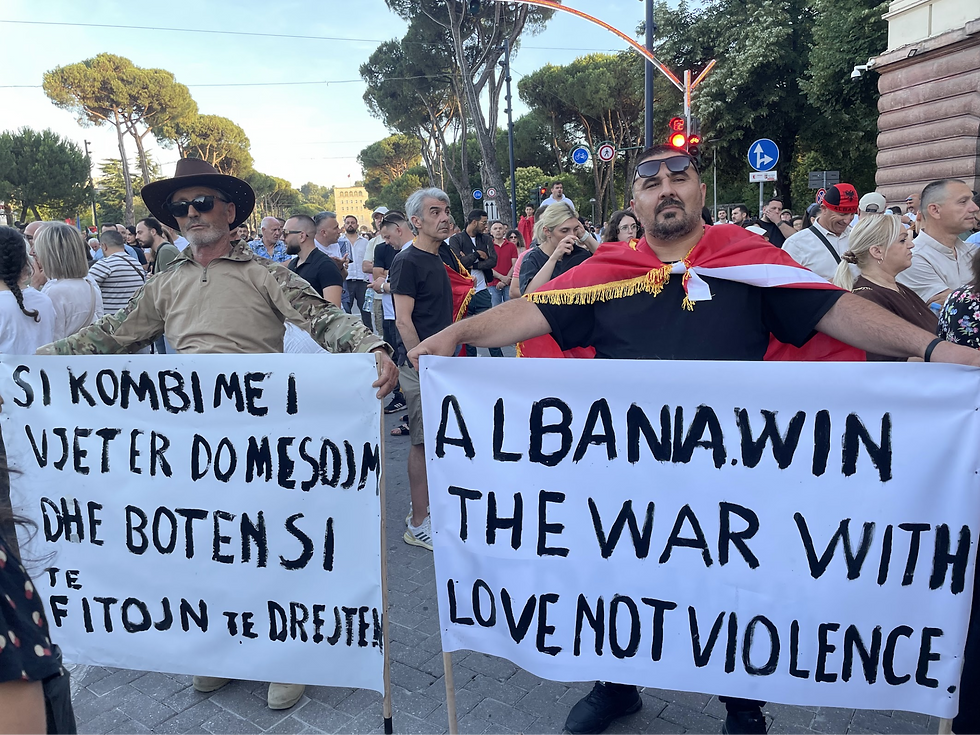
This October, the overwhelmingly peaceful protests turned violent after four months of demonstrations yielded little response from the government. State Police General Director Hita, who expressed remorse about the failure to protect protesters in Zvërnec, has deployed a police crackdown of a scale and intensity not seen in years, as Prime Minister Rama’s grip on power is seen as more tenuous than ever. Nika warned that the path ahead will be treacherous. “Our elites make the rules, play the games, and share the benefits. We are just numbers. This is what the crowd is aiming to change. If the protests don’t produce clear political demands and all this energy is not put into producing a coherent plan, we will have to wait another 30 years until the next student protests erupt. But I believe that this system is at the end of its journey in Albania and elsewhere in the Balkans.”
The Flamingo Revolution has taken broad form, and has long stopped being just about the species which granted its name. Yet they are no less important. “We insist on the environmental aspect because it’s about our dignity and identity as a country. That’s what our nature represents actually; it is tied to our history as a people, and if these values are gone, we will have lost connection with who we are,” Nika hurriedly tells me before rushing off to his next meeting. He is short on sleep, yet he will head to the protest afterwards regardless. Like many of his peers, he will continue to do so for many days to come.
Eleftheria Kousta is a freelance journalist covering the stories of civilians in conflict, refugees and protest movements.
Arbanon Magazine remains committed to detailed coverage of the ongoing major protest movement in Albania. Please feel free to reach out with any pertinent information to arbanonmedia@gmail.com.


Comments