
Where Does Albanian National Identity Come From? A Book Review of Albert Bikaj’s The Genesis of National Thought
Author: Valton Vuçitërna
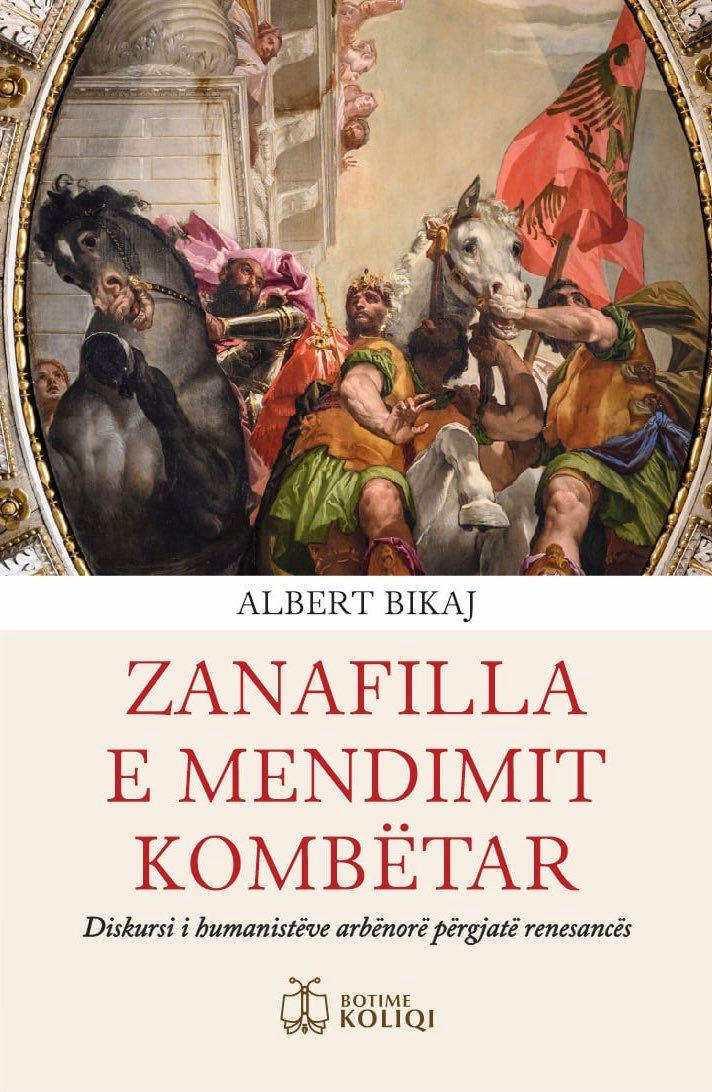
There are books that adequately fill in some of the many remaining gaps in the fields of history and anthropology. Yet there are others which so eloquently deliver their thesis that one cannot help but view them not as merely filling a void but opening new doors. Albert Bikaj’s The Genesis of National Thought: The Discourse of Albanian Humanists During the Renaissance (Zanafilla e Mendimit Kombëtar: Diskursi i Humanistëve Arbënorë Përgjatë Renesancës, 2025) is one such example. It is a work of true scholarly ambition: carefully sourced, methodologically clear and drafted with an intellectual seriousness that has been lacking in much of Albanian historiography. It also contains a central theoretical tension which its author never fully resolves; yet, in my view, this should not be seen as a flaw as much as an invitation — one that speaks to the genuine complexity of the matter at hand and invites a deeper conversation rather than settling for an insufficient final answer.
Bikaj’s Argument
Let us begin by narrowing in on what Bikaj is actually doing, because this book can be rather easily misread. It is neither a straightforward celebration of Albanian humanist achievement nor a work of nationalist advocacy dressed in academic garb; it is rather something both more intricate and interesting altogether.
Bikaj’s central argument is that national consciousness — the sense of belonging to a distinct people with a shared language, origin, territory and heroes — did not emerge suddenly in the 18th century as claimed by influential modernist scholars like Ernest Gellner, Eric Hobsbawm and Benedict Anderson. Instead, Bikaj contends that national discourse emerged gradually from the fabric of Catholic Europe, having been facilitated by the Renaissance and driven by humanist intellectuals who gave identity a literary form. He draws heavily from the paradigm developed by the Swiss historian Caspar Hirschi to contend that Albanian humanists like Marin Barleti, Dhimitër Frangu and Marin Beçikemi were not passive recipients of Renaissance ideas but rather agents who actively and deliberately sought to shape distinctly Albanian national discourse in the context of the diasporic community of Venice.
His position places Albanian intellectual history firmly within the broader European development of national thought, centuries earlier than is acknowledged by much of modern historiography. It is worth noting, however, that some works, especially in recent years, have made important headway in retracing the Albanian presence in broader European and Mediterranean networks of exchange — intellectual, political and economic. Perhaps the most notable among these is Sir Noel Malcolm's 2016 volume Agents of Empire: Knights, Corsairs, Jesuits and Spies in the 16th-Century Mediterranean World, which highlights the various and complex ways in which members of a single Venetian-Albanian family served several empires.
The main methodological tool Bikaj utilizes is imagology, a branch of comparative literature that analyzes how collective identities are perceived and constructed through text, especially across national lines. Bikaj traces four key topoi — common themes — in the works of the Albanian humanists: the myth of national origins, geography, characterology (the study of human personality) and heroes. This analysis results in a systematic and organized reading of the works produced by the era's Albanian humanists, which have long served as historical sources yet rarely subjected to this kind of examination.
In personal conversation, Bikaj describes his theoretical position as that of a traditionalist constructivist; this means that he thinks of the nation as having deep historical roots, yet requiring an extended developmental process and articulation in order to take the form it eventually assumed. He is neither a modernist who would deny any meaningful national consciousness prior to the 18th century, nor a primordialist who would assert that nations are a natural, eternal and biologically fixed concept. Bikaj occupies a middle ground that acknowledges both pre-existing ethnic identity and active intellectual work required to translate this material into national discourse. I see this as a defensible and intellectually honest position, one that deserves to be engaged with on its own terms before examining where its logic leads.
Where the Work Succeeds
It would be an injustice on my part not to acknowledge what Bikaj executes adequately and how much he gets right, even in ways that are rare in this field.
The book’s greatest strength is its command of primary and secondary sources alike. Bikaj moves fluidly between Latin humanist texts, Venetian archival material, Albanian historiography from both the communist and post-communist eras as well as a wide range of European scholarship on nationalism. In addition to the aforementioned oeuvre of Hirschi, he cites Fan Noli, Oliver Schmitt, Athanas Gegaj, Zrinka Blažević and Lucia Nadin — all with deep and sustained intellectual engagement. The bibliography he puts together is in and of itself an immense contribution to the discipline; for any student or scholar looking to enter this field or push its boundaries further, Bikaj has already done the foundational work of assembling a robust and navigable body of literature from which to depart.
The reconstruction of the Venetian-Albanian diasporic community is particularly impressive. To my knowledge, it is the most thorough account in Albanian-language scholarship to date. The chapters describing the society in which the Albanian humanists operated provide the book a historical structure which most theoretical works on nationalism regrettably lack. This strength takes the narrative beyond abstract intellectual history. Bikaj grounds his humanists in a real, breathing community of refugees who actively navigated what it meant to be an Albanian in exile, and employed diplomatic and cultural tools to ensure that Europe recognized it, too.
Alongside this, Bikaj offers pointed and fair critiques of Albanian Marxist historiography. He identifies the ideological distortion brought on by scholars like Aleks Buda and Androkli Kostallari, who projected secular nationalist values onto the humanists without regard to the equally central religious dimension of their discourse. Barleti and Frangu both wrote pro fide et patria — for faith and homeland simultaneously — holding this dual commitment as the governing ideal of their work. Any reading aiming to remove this religious element misrepresents not just their work but what they believed they were doing. More broadly, communist historiography, as he observes, tended to treat Enlightenment secularism as a “natural” and ancient Albanian characteristic, altogether denying the genuinely religious element of Medieval Albanian national consciousness. Bikaj restores the balance rather impressively, which I view as the book’s sharpest and most original critical insight.
Bikaj is also consistently fair with positions he stands against. His critique of the modernist school on national thought is never caricatured, but sharp and thorough. Take as an example his engagement with Enis Sulstrarova’s Orientalist reading of Barleti. Sulstarova applies this lens — drawn from Edward Said’s influential postcolonial framework — to Barleti’s anti-Ottoman writings, treating it as a form of “othering” that reproduces structures of cultural domination. Bikaj finds this not only ideologically motivated but also analytically incoherent. Said’s framework aimed to describe Western imperial power projecting itself onto a colonized East; its application to an exiled Albanian priest writing in defense of his people and land of birth against an overwhelming imperialist force inverts the very power dynamic the framework was created to analyze. Though Bikaj finds Sulstarova’s position anachronistic and ideological, his treatment remains precise and measured.
He also acknowledges the contribution to Albanian cultural history by the Angeli dynasty — a noble Albanian family of Byzantine imperial lineage who settled in Venice following the Ottoman conquest and played a role in financing the projects of the humanists. This factor has been insufficiently recognized: an inclusion that is not always easy to execute, or even common in modern historiography. Bikaj’s style of prose is similarly precise and controlled, remaining appropriately formal without becoming arid — always a commendable and difficult skill.

The Political Dimension: Constructivism’s Strongest Case
Before turning to the theoretical essence at the heart of the book, I would like to dwell on a strength that deserves particular emphasis: the author’s efforts to highlight the unmistakable political character of the humanists’ writing, and what it reveals about the nature of their intellectual project.
Barleti, Beçikemi and Frangu were not writing independently of the complexities that defined the society around them. They were exiles, members of a community in Venice that had lost its native standing at the hands of sweeping Ottoman conquests and were now protected under the patronage of their host society. Their political situation profoundly affected their writing in ways that Bikaj effectively identifies and which, indeed, a responsible reading of their works cannot ignore.
Barleti explicitly presents Albanians as exclusively loyal to the Republic of Venice, recognizing none but the Doge as their legitimate ruler. Frangu describes the Albanians as the shield of the Alps and faithful defenders of the Pope and Christian kings. Beçikemi's Panegyricus is, as such a piece of writing demands, laden with praise and as such does not necessarily reflect an objective historical narrative. These authors relied on their Venetian benefactors for the survival of their exiled community and the ability to continue their cultural and diplomatic efforts. It would thus be dishonest to read their works as unfiltered expressions of ethnic pride or nationalistic fervor. As always, the political environment and the audience at which they directed this discourse must be considered in any full examination.
The humanists framed the Albanian cause in terms that every major Christian power would be likely to understand and positively receive. This is most evident in Barleti’s formulation of Albania as the antemurale Christianitatis — the shield of Christendom. This title, which Barleti employed strategically, was bestowed on Albania by Pope Pius II. It is important to note that relations between Venice and the papacy were frequently volatile and strained, being marked by disputes over the authority of the Church and the political independence of the thalassocratic northern city-state. Yet in the context of anti-Ottoman resistance, the interests of both powers converged. Both parties had direct reasons to oppose the encroaching forces of the Sublime Porte: Venice seeking to maintain the commercial empire they had developed in the Eastern Mediterranean, and the papacy yearning to organize a renewed crusading response after the theopolitical catastrophe wrought by the fall of Constantinople in 1453. As such, it is clear enough that Barleti was invoking the authority of the Pontificate in an attempt to appeal to broader Christendom, including the interests of Venice.
The immediate political needs of his community led him to emphasize a narrative of loyalty to Venice — a strategic intellectual effort which Bikaj’s imagological framework captures with sophistication. It is a construction in the most faithful use of the word. As Bikaj documents, the translation of Barleti’s Historia into several European languages was also far from accidental; it represented a purposeful step at diffusing the Albanian cause, making it legible and compelling to the rest of the continent.

An excerpt of the document, dated to 1462, in which Archbishop of Durrës Pal Engjëlli writes the baptismal formula in Albanian: “I baptize you in the name of the Father, the Son and the Holy Spirit.” In modern standard Albanian:“Unë të pagezoj ne emër të Atit, të Birit dhe të Shpirtit të Shenjtë.” This is the oldest authenticated text in the Albanian language.
Theoretical Tension: What the Evidence Suggests
There are points in some books at which one stops merely reading and rather begins arguing with the text. In this case, this was driven by the growing sense that the evidence Bikaj presents, combined with what scholars now know from genetics, anthropology and linguistics, consistently points towards a continuity deeper than what can be explained even within his generous framework. It is by no means a fatal flaw nor an inescapable contradiction but at least imposes pressure on the framework; which, in my view, pushes his traditionalist constructivism towards, especially in the Albanian case, something very close to primordialism.
Bikaj builds his work on Hirschi’s claim that national discourse began to take shape in Medieval Christendom and was developed by the humanist movement of the Renaissance. I find this to be a defensible and robust challenge to modernist thought. However, Hirschi’s ideas trace the foundations of these developments through the legacy of Roman imperialism, back to the core of the Empire itself. Notably, ancient Rome was already a world in which the identity of the Latin substratum as distinct from broader Roman consciousness was fully operative — which seems to call constructivism into question.
For example, the mos maiorum — the custom of the ancestors — was not a generic Roman civic concept. It was distinctly Latin in origin and deeply ingrained into their collective ethnic identity; it bound these Romans to the practices, pieties and norms of their Latin forebears as a living inheritance. This can only be meaningfully understood as ethnic consciousness. It presupposed a specific line of descent: a community defined by shared ancestry rather than merely shared law. This carried an implicit distinction between those who carried this inheritance and those who did not.
Rome in its later years was committed to a universalist self-image — anyone could become Roman under a certain set of criteria. Yet this sat in permanent tension with the framework of the mos maiorum, an inherently particularist and ancestral practice. The old gentes, the great clans like the Julii with their family trees and ancestral masks — beeswax face molds of Roman elites — carried something that a new citizen from Hispania could not acquire simply by learning Latin or obtaining citizenship. Roman identity thus simultaneously operated on two levels: a civic and expansive outer layer as well as an inner, Latin ethnic core that could not be dissolved.
This does not abruptly start in Rome. The Eternal City inherited numerous such conceptions of civic and ethnic distinction from the earlier Latins, whose own ancestors carried forms of in-group and out-group distinction that predate any written record. At some point in this chain, the distinction between constructed discourse and primordial identity becomes muddled. This emerges because the construction has continued for so many generations that it grows indistinguishable from nature; importantly, not because the distinction is meaningless.
Bikaj’s argument that German or French national consciousness required active Renaissance construction possesses genuine force, precisely because these identities were shaped by post-Roman events. German-speaking humanists needed to reach back to Tacitus to find a description of their ancestors, and argued about whether Charlemagne — King of the Franks, as we should be precise about — belonged to them or the French. The ethnic boundaries between the two were genuinely contested, notwithstanding the obvious separation in language, and thus somewhat ambiguous because of their interlinked histories. In stark contrast, Albanian ethnic boundaries were relatively clearer.
Consider the Albanian community in Venice as Bikaj describes it. The Stradioti — predominantly Albanian soldiers recruited from communities in Greece — were immediately recognized by the Venetians as Albanian and helped shape the host society’s perception of what it meant to be a member of that ethnic community. The Stradiotis’ consistent rejection of Greek command speaks to a sincere and sustained ethnic boundary. Archbishop Pal Engjëlli, of the aforementioned Angeli dynasty, would commit to writing what is, as far as modern scholarship has determined, the first written example of the Albanian language in the form of the Christian baptismal formula (formula e pagëzimit). This contribution was not a wholesale linguistic invention, but the transcription of a long-standing tongue that, as we now know, carries one of the most remarkable stories of ethnic continuity in Europe. Indeed, the ancient Indo-European vernacular stands as the only modern representative of its branch.
The genetic record is the most recently developed pillar of this evidence, and the findings are striking enough to require its consideration in any full analysis of Albanian identity. A landmark 2023 genomic study found remarkable continuity of West Balkan Late Bronze Age and Iron Age ancestry in Albania through the early Medieval period, a phenomenon distinct from every neighboring region. The oldest samples of the three Y-DNA haplogroups most strongly associated with Albanian men were found in historically Albanian-inhabited territories, and are all attested in the region since the Bronze Age. Slavic admixture, when it arrived, was predominantly female-mediated. This means that Slavic women married into Albanian communities while the latter's paternal lines remained broadly intact. To put it simply: biological evidence speaks to continuity stretching back three to four thousand years in the Western Balkans. This is all in spite of countless invasions, migrations and conquests. It is not the genetic profile of a people that required construction in the 15th century. Rather, it points to one of the most continuously rooted European populations in history.
The next significant pillar of this continuity is represented by the Kanun, the customary law code for much of the Albanian people. Today mainly cherished by the Ghegs of the North, it was once upheld — in one variant or another — in most of Albania’s ethnographic regions. For centuries, it was sustained through oral transmission and provided near-total direction of tribal life. Its strong pre-Christian and pre-Islamic motifs reflect the stratification and continuity of Albanian law through the ages. Scholars of comparative law have often noted that the Kanun's traditions find echoes in Vedic India and the practices of ancient Greece and Rome. These comparisons suggest an inheritance from Proto-Indo-European customary legal culture as opposed to a local invention at any identifiable moment, similar to the aforementioned mos maiorum. The Kanun operated as a constitution of a stateless social system: self-sufficient and operating without the support of an external institution, and binding beyond religious lines. It is a powerful piece of evidence that Albanian ethnic identity operated at a more fundamental level than any externally imposed structures.
The oral traditions of the Albanian people reinforce this picture. Their mythology has inherited the Indo-European epic genre focused on warriors of the past in the form of the Kângë Kreshnikësh; which contain similarities to the traditions of early Greece, classical India, the Anglo-Saxon kingdoms, medieval Germany and the South Slavs. Though some songs’ subjects can be found in their South Slavic counterparts, the elements in the Albanian version are of Paleo-Balkanic origin with pre-Christian cosmological motifs. Half a million verses of the Kreshnikët cycle have been collected after centuries of oral transmission by skilled rhapsodes without any institutional support — by any measure, a remarkable feat.
These structures functioned as the invisible libraries of the Albanian people, a transmission mechanism which Bikaj’s traditionalist constructivism implicitly requires to explain how ethnic consciousness survived between, and even before, the fall of medieval Albanian political structures and its articulation by the humanists. Such a mechanism, once acknowledged, seems to collapse the aforementioned tenuous distinction between “constructed discourse” and “primordial identity.”
Finally, as discussed in a previous article, religious conversion provides some of the most substantial evidence for the depth and resilience of Albanian ethnic consciousness. When the Albanians converted en masse to Islam during the Ottoman period, undoubtedly influenced by the economic repression faced under the Sublime Porte, they maintained an Albanian identity, distinguishing them from other ethnic groups in the region. Many among other converts to Islam, like the Pomaks and the Bosniaks, developed a close association to their faith which bled into their ethnic self-perception, despite the Bulgarian origin of the Pomaks and the close association of Bosniaks with various sects of Christianity prior to Ottoman conquest. The Albanians largely did not fall into this conflation, however, and held onto their uniformity alongside Catholic and Orthodox Christian compatriots.
Barleti himself was aware of this dynamic when he described the Albanians, stating that even when they “become Turks” — that is, convert to Islam — they do not show dedication to the faith and never become “good Turks.” While one could argue that Barleti was attempting to satisfy the Venetians with this description, the notably lax attitude and generally syncretic behavior towards Islam widely observed among the Albanians — the prevalence of the Bektashi Order being a prime example — provides some weight to the claim. As such, even the powerful assimilatory force of religion did not dissolve Albanian identity. This points to an ethnic consciousness operating at a depth that no humanist, however admittedly brilliant, could have constructed from scratch.
Engaging the Counterargument
Bikaj would surely push back on the perceived theoretical tension above. Cultural continuity through social habit and geographic isolation is not immediately indicative of ethnic consciousness. That is, awareness of and participation in a named community with a shared history and boundaries that distinguish them from surrounding peoples do not equal a nation. A people are fully capable of articulating their thoughts through a shared language and abiding by the same tribal law for centuries without producing the kind of structured, reflective national identity that Bikaj traces through the humanists. In this view, the raw material requires an act of genuine intellectual conversion in order to be fully legible, a conversion which the Albanian humanists performed. Much of the weight borne by Bikaj’s constructivism rests upon this important distinction. Without it, the humanists become mere stenographers of a pre-existing reality instead of active contributors to something new, posing a problem for the book's central claims.
And yet, this distinction proves less than the constructivist framework — at least in the Albanian case — requires it to. A careful examination of the evidence Bikaj presents consistently reveals a community whose behavior demonstrates an operative ethnic consciousness. Observable genetic continuity reinforces this consciousness and boundary, as a strong biological expression of the maintenance of social and ethnic distinctions. The fact that medieval Slavic admixture entered the Albanian gene pool through the maternal, and not the paternal lineage, and the continuity of high Paleo-Balkanic admixture is a biological signature of sustained endogamy, the practice of marrying within a group. It speaks to a community that was actively maintaining a cultural barrier against outsiders across centuries of significant Slavic incursions and conquests. This extent of endogamy does not occur randomly; it is instead an active social enforcement of ethnic boundaries.
This understanding is even built into the Albanian language, which has preserved a specific term used to refer to outsiders, typically neighboring ethnic groups. The Ghegs of the North used shkja for Slavs, the Arvanites shkla for the Greek population, and the Arbëreshë describe the Romance speakers of the Italian peninsula as using shklerisht and being shklan — one who speaks an incomprehensible language, as opposed to shqiptar — one who speaks clearly, or a speaker of the Albanian language. While some of these terms are perceived as conveying an offensive meaning in the present day, their historical distinguishing role is clear, as also evidenced by the presence of equivalents in many languages.
It is difficult to develop a stable and meaningful term to describe the Other without a prior and operative sense of Self. This distinction predates literacy, modern political discourse and, indeed, the humanists. Importantly, there has historically been not merely a descriptive but also a normative, boundary-policing function to such behavior, implying a socially enforced identity and not just a retroactive perception.
We must note that Barleti’s contribution was not the creation of an Albanian national identity. As the next section will further demonstrate, he rendered an operative, conscious identity into a form that courts and academies throughout Christendom could receive. The distinction that matters, then, is not whether a meaningful ethnic consciousness existed or not. Rather, it is between consciousness as lived community practice and as classical literary articulation. Both are certainly real, but only the second required a humanist to craft it into being.
Holding Two Thoughts At Once
Having laid out this evidence, I want to be careful about what I am arguing and what I am not. The strongest version of the primordialist case, taken alone, would provide an incomplete account of what the Albanian humanists were doing, and risk an unfair reading of Bikaj’s position. The author is correct in stating that the humanists were doing something that requires development beyond mere documentation. However, I argue that they were carrying out this task in two ways, each meaningfully different from the other.
Firstly, they were translating an existing Albanian identity — one already ancient and biologically rooted, held together through legal self-sufficiency in an isolated language — into the classical humanist idiom that Renaissance Europe demanded of peoples wishing to be taken seriously.
Secondly, they were strategically shaping that translation for Venice and Europe according to the political requirements of their exiled community. Admittedly, this translation contained genuine constructive elements: choosing which ancestral population to invoke, framing the Albanian resistance as a defense of Christendom and emphasizing loyalty to Venice. These choices were consequential in shaping how European powers would perceive the Albanians for generations.
But here is where the tension between traditionalist constructivism and the evidence grows most acute. Bikaj’s framework holds that national identity is deeply rooted in a people’s history but requires an extended developmental process to take shape. As previously stated, this is a reasonable and defensible position in the abstract. The evidence in the Albanian context, however, poses the following question: how extended can this developmental process be, and how deep must these roots go before the language of “construction” and “development” becomes redundant to describe what is in fact continuity? At what point does gradual construction become a descriptor of, in every meaningful sense, what was already there? We have observed such stability in genetic connections tracing back to the Bronze Age, millennia-spanning linguistic continuity in the same territory, a self-sustaining ancient legal code and pagan-rooted oral traditions preserved even through conversions to powerful faiths.
Bikaj’s position, pushed to its logical conclusion in the Albanian case, converges somewhat with primordialism. This is not because Bikaj is mistaken about the intellectual contribution of the humanists, but because the substratum their work was based on was of such old and resilient origin that it becomes increasingly difficult to identify what is constructed product and what is raw material. In my view, these writers gave the Albanian people a voice that could be heard by Europe; however, the identity itself — the language, the genetics, the kinship structures, the oral customs and laws — did not wait for Barleti to spring them into existence. Indeed, by the time of his birth in the mid-1450s, it was already ancient and it will likely outlast any theoretical position scholars develop to describe it.
I hope it is clear that I am not attempting to undermine Bikaj’s thorough work in this critique. If anything, it is a recognition of how deep the implications of his observations run. By assembling such detailed evidence of Albanian cultural, political and institutional life in the 15th and 16th centuries and tracing the intellectual genealogy of Albanian national discourse through Hirschi’s paradigm, Bikaj has produced scholarship whose evidence points further than its framework intends. A theoretical account that can integrate humanist discourse, transmission of pre-modern identity and the ancient depth of Albanian linguistic and genetic continuity without forcing an insufficient choice between them is in need of development. Bikaj’s work makes this path both more possible and urgent.

Conclusion
The Genesis of National Thought is an important book in many ways: for Albanian historiography, the study of humanism during the Renaissance and as a serious contribution to broader debates on nationalism that have often ignored the fascinating Albanian case. Bikaj writes with rigor, intellectual honesty and a command of sources that far elevates the field. Currently available in Albanian, an authoritative translation to English would do much to integrate it in broader academic and cultural conversations.
The theoretical tension the book opens between constructivism, whether modern or traditional, and primordialism is not a failure of the scholarship. In my view, it proves to be its most generative feature by pointing to a frontier in the study of Albanian identity that is only now becoming fully legible. Bikaj has extended a new generation of scholars on the Albanian world both the evidence and the intellectual provocation to cross that frontier. It is no small legacy for a single book to leave — and one I am sure Barleti would have recognized.
Arbanon Magazine welcomes responses to this review from our readers and scholars working in Albanian and Medieval historiography, nationalism studies, sociology, psychology and genetics. Please leave your thoughts in a comment below and contact us at arbanonmedia@gmail.com.
Valton Vuçitërna is a third-year student studying Finance at Michigan State University's Eli Broad College of Business. Valton was born and raised in Grand Rapids, Michigan to parents from Kosova. He is the founder of The Anadrini Project, a database designed to record the histories and genetics of families in Kosova's Anadrini region, as well as the history of the town of Rahovec. He is interested in European history and the cultural heritage of the Albanian people.


Comments