
Where is Ukshin Hoti? The Life and Enduring Thought of Kosova's Martyred Philosopher
Author: Valton Vuçitërna
There is a region in the western fold of the Republic of Kosova, nestled between the sweeping fields that make up the Plain of Dukagjini and the first gentle risings of land toward Llapusha and the Drenica Valley, which has long produced more than just the fruits of agricultural effort. The region is known to its overwhelmingly Albanian population as Anadrini – meaning on the banks of the White Drin, the small republic’s longest river. At the epicenter of the fertile viticultural region, one finds the town of Rahovec: a settlement that serves as the intermediary between the larger cities of Prizren and Gjakova. The town’s roots reach past the Ottoman centuries and medieval Serbian princedoms, deep into Roman and proto-Albanian presences.
Anadrini, however, has contributed more to history than viticulture and a Paleo-Balkanic inheritance. Although the region has remained largely obscure in the broader Albanian world, it has bred countless patriotic figures and movements, standing as a quiet bastion of the Albanian struggle through the ages.
The town of Rahovec has also been home, in its own modest way, to a tradition of Albanian intellectualism that has long permeated the agricultural region. This is best exemplified by the Sufi sheikh of the Melami order Abdylmaliq Hoxha – known throughout the town as Sheh Mala. Born in the ancestral village of the Krasniqi tribe-descended Hoxha family in 1865 prior to their resettlement in Rahovec, Sheh Mala was renowned for his divan – a collection of Islamic poetry written in the Gheg Albanian dialect of Anadrini. The works are composed in the elifbaja script, adapted from Arabic in order to properly compose Albanian orthography. At the time, Albanian-language poetry and writing more generally were rare in the confines of western Kosova. Sheh Mala’s work gave poetic form to the inwardly ascetic and self-reproaching theology of the Melami Sufi order.
Among the notable intellectuals of Rahovec who preceded and enlightened the generation that emerged following the 1999 Kosova war was Dr. Sabahajdin Cena, a professor of Albanian literature who became known in his native town for an unyielding insistence on the purity and dignity of the Albanian language. Cena was driven, above all, by a fierce nationalistic sensibility. It was precisely this principle that led Yugoslav authorities to bar him from teaching at Rahovec’s high school and force him into administrative obscurity. Cena’s fate was typical of Anadrini intellectuals who faced punishment for demonstrated capacity and dedication. This reality would sadly persist in the post-war republic, with Cena remaining a largely obscure personality until his death in 2023. This outcome was facilitated by politicians and laymen alike, who undervalued his scholarly contributions and immense hunger for national and linguistic integrity.
It was from this soil – more precisely the village of Krusha e Madhe, the heart of Anadrini – that Ukshin Hoti emerged. It is worth beginning with the geography that shaped the man, as no individual is fully separable from the ground beneath his feet. Hoti would spend much of his adult life imprisoned and exiled, withstanding constant harassment and finally disappeared. However, it is no mere metaphor to describe him as a figure firmly rooted in this landscape.
Hoti, as I stated in a previous article, was “truly the Alexis de Tocqueville of the Albanian late 20th century – a great mind who combined metaphysical inquiry through philosophy with political activism, valuing the self-determination and liberty of his people while also seeking to balance freedom with order and national consciousness.” What follows is an attempt to do the complexity of such a mind justice; to tell the story of his life with a precision it has yet to receive in the English language. This means reading his thought with the seriousness it deserves and earnestly evaluating what his legacy amounts to.

From Krusha e Madhe and Back
Ukshin Hoti was born on 17 June 1943 in the village of Krusha e Madhe, part of the municipality of Rahovec and, at the time, an administrative unit of the Italian-occupied Kingdom of Albania. He came into a war-torn and chaotic world and was raised in a rural community which 56 years later would see one of the most thoroughly documented massacres of the 1999 war committed by Yugoslav forces against Albanian civilians. As such, violence was not foreign to the land that begat Hoti – a reality that would impact both the man and the family he emerged from.
Hoti was the eldest of six children in a household managed by his mother Fatima in the traditional fashion of Anadrini women. His father Nazif ran a newspaper kiosk stationed in front of the local school, which served as the family’s sole source of income. It was in this context that Hoti came to an early realization of his passion for the social sciences and pursued his studies with remarkable ambition and range. Between 1964 and 1970, he completed his schooling in political science at the Universities of Zagreb and Belgrade, undertaking rigorous coursework that exposed him to Yugoslav political theory and the socialist federation’s international relations. He then returned to Kosova, beginning work for the administration of the parliament, newly strengthened by the 1974 Yugoslav constitution which granted Kosova substantial autonomy. In 1975, he began lecturing on political science and international law at the University of Prishtina.
It was as one of the newly autonomous Kosova’s leading diplomatic minds that Hoti published his first book, The Cold War and Détente (Lufta e Ftohtë dhe Detenti) in 1976. The work marked the onset of the integration Hoti sought between his social and scholarly roles – reflecting the inseparability of theory and practice he upheld. Between 1977 and 1978, at a time when he served as Secretary of Foreign Relations at the Provincial Assembly of Kosova, Hoti was awarded the prestigious Fulbright Scholarship. He was hosted at the University of Chicago under Dr. Eric Hamp and at Harvard University under Dr. Benjamin Brown. This accomplishment brought Hoti into the sphere of American academia and cemented him not simply as a regional activist dignitary but as a serious scholar enjoying bona fide international standing.
Hoti’s trajectory at this stage in his career placed him at an extraordinary crossroads. He was not merely an Albanian political theorist producing work under the shadow of Yugoslav occupation. Hoti returned to his native Kosova imbued with the intellectual tradition of the West; having efficiently digested what the canon had to offer, he was determined to use it critically to advance the self-determination of the Albanian people.
It was during these years of professional formation in Prishtina that Hoti met and married Edi Shukriu, a figure deserving of recognition in her own right. Born in Prizren in 1950, Shukriu became one of Kosova’s most distinguished archaeologists — notably being responsible for the 1988 discovery of the Goddess on the Throne Neolithic terracotta figurine in Vitia. This finding was akin to another in 1956 which later became the symbol of Prishtina and the Dardanian heritage of Kosova’s Albanians. Shukriu was also known as an accomplished poet. The two lived together in Prishtina’s Ulpiana neighborhood, with their marriage representing the union of two among the most decorated Albanian intellectuals of their generation.
The couple had a daughter, whom they named Erleta. However, the marriage soon began to strain as Hoti’s career progressed, particularly under escalating political persecution following the 1981 student protests in Prishtina, in the facilitation of which Hoti played an active role. On May 21, 1982 Hoti was arrested by the Yugoslav authorities and received an initial sentence of nine years. Shukriu appealed the conviction in a Belgrade court, securing a reduction to three-and-a-half years by challenging the legal basis for the trial. The court based his imprisonment on the charge of “criminal offenses aimed at overthrowing the power of the working class and laborers, breaking ‘brotherhood-unity,’ violating the equality of nations and nationalities and unconstitutional change of the federal regulation of the Socialist Federal Republic of Yugoslavia.”
Hoti served the sentence in several prisons throughout Yugoslavia. It was in the penitentiary of Gjilan in eastern Kosova that he would face the greatest obstacle, as books and pens were forbidden to him. This severed Hoti from the intellectual lifeblood that sustained him. In response, he initiated a 12-day hunger strike to be transferred back to the prison in the Slovenian capital of Ljubljana. This proved successful and Hoti was moved to a location where he would be able to read and write.
Hoti was released from his sentence in April 1985, though his matrimony with Shukriu came to an end through a difficult divorce catalyzed by the constant surveillance and isolation imposed by the Yugoslav state. This created a deep asymmetry between a man who made the dignity and moral liberty of Kosova the nucleus of his existence and a partner who needed to raise a daughter through conditions of deprivation and scrutiny. Following the divorce, Hoti returned to Krusha e Madhe into a life of quiet solitude. Yet it was during this decade of enforced silence that he produced most of his magnum opus, The Political Philosophy of the Albanian Cause.

UNIKOMB: Its Founding Program and Ideology
Among the most consequential political actions Hoti took on was his leadership of UNIKOMB – the Party of Albanian National Union, (Partia e Unitetit Kombëtar Shqiptar). The party was originally founded by Halil Alidema, one of Hoti’s closest collaborators following the 1981 demonstrations and their subsequent arrests. UNIKOMB’s founding served as the manifestation of the men’s pledge to continue the struggle for Albanian liberation after their release from prison.
From the outset, the party positioned itself as a staunchly nationalist alternative to the larger, more cautious Democratic League of Kosova (Lidhja Demokratike e Kosovës or LDK) led by the statesman Ibrahim Rugova. Famously, Rugova advocated for a more patient and non-violent resistance within the framework of the Yugoslav status quo. UNIKOMB’s approach, by contrast, went much further. The movement’s foundational ideology prioritized the idea of national union (bashkim kombëtar). Hoti and Alidema insisted that the Albanian question in Yugoslavia could only be resolved through the political unification of the Albanian-speaking territories, rejecting any incremental autonomy or loose federation within a rump Yugoslav state.
Concretely, their platform advocated for the unification of Kosova, Albania proper, the western portion of North Macedonia, areas of southern Montenegro and the Presheva Valley into a single sovereign Albanian state. The movement combined this pan-Albanian core with a commitment to democratic governance and the integrity of rule of law, which Hoti rooted in the international community’s norms of democratic legitimacy. He assumed leadership of the party in 1994 following Alidema’s death the year prior; yet he would never make it to the inaugural meeting honoring his elevation.
On May 17, 1994, en route to formally take up his new position in Prishtina, Hoti was arrested by Serbian police in Prizren. The Yugoslav state’s rationale was based on Hoti’s purported membership in the illegal People’s Movement of Kosova (Lidhja Popullore e Kosovës, also PMK or LPK). The initially “Marxist-Leninist” movement was formed on 17 February 1982 within circles of the Albanian diaspora in Switzerland and Germany, notably led by brothers Jusuf and Bardhosh Gërvalla and their associates. The movement oriented itself towards Enver Hoxha’s Albania following the 1981 demonstrations, not solely out of ideological sympathy but at least as much as a model of salvation from the domination they found themselves under. Indeed, the harsh conditions Kosova’s Albanians faced had obscured much complex history, including Hoxha’s support for Kosova’s reintegration into Yugoslavia following World War II, partially a product of the close ties and near subservience the Albanian Partisans’ leadership maintained with Yugoslav counterparts like Miladin Popović. On 1 October 1990, the PMK became a sub-group of Ibrahim Rugova’s Democratic League and thus shifted from their position as “Hoxhaists.” Many of its members would later help establish the Kosova Liberation Army.
In September 1994, Hoti received his second sentence: five years in the penitentiary of Dubrava near Istog in northwestern Kosova. He found himself in the isolation of prison once more due to his supposed alignment with the PMK, though he neither espoused Hoxhaist sympathies nor was allied with Rugova. He was also accused of founding and financing the newspaper DeA; actions which came together to endanger “the constitutional order of Serbia.”

A Foreboding Day
The five years Hoti spent in prison did little to hamper the intense intellectual productivity he had cultivated for decades. This work led to his 1998 nomination for the Sahkharov Prize for Freedom of Thought by the European Parliament. Hoti came in third in the vote total but his compatriot Rugova received the honor that year. This represented a remarkable achievement for Kosova, which had produced some of its most capable intellectuals under years of intense repression. The two men were united by a common liberatory cause, though they pursued their aspirations through different means. Rugova famously modeled cautious restraint, while Hoti upheld the active, though peaceful, principle of resistance.
The Sakharov nominee became a cardinal figure of orientation for the inmates with whom he shared the woes of imprisonment, completing The Political Philosophy of the Albanian Cause in 1995. This became a corpus of speeches, letters and other writings that spanned the thinker’s career. Hoti managed to smuggle the erudite work past the guards of Dubrava, with fellow detainee Gani Baliu receiving a copy.
On 16 May 1999, nearing the conclusion of his sentence, a prison guard visited Hoti and instructed him to prepare to leave. Hoti followed suit and began gathering his scant belongings. Baliu offered him a cherry-colored sweater and a long-sleeved shirt, as Hoti lacked sufficient clothing apart from the vest his sister Myrvete had previously brought. Another prisoner lent him a pair of jeans. We can hardly perceive this as anything but a quiet cruelty; a man so close to tasting liberty walking out of prison in clothes that belonged to others. Witnesses including Baliu and fellow political prisoner Hajredin Hyseni recall Hoti being escorted by two guards while carrying a bag of books. They reported feeling uneasy that Hoti’s release came on a Sunday, which they described as unusual. He would never be seen again.
NATO would bomb the Dubrava prison area just days later, striking the penitentiary on May 19 and 21, citing the presence of Yugoslav military activity nearby. On the morning of May 22, Serb security units and armed prisoners were likely joined by paramilitary forces in lining up the approximately 1,000 Albanian prisoners in the courtyard to swiftly open fire with grenades, sniper rifles, machine guns and more from the prison walls and guard towers. The initial onslaught killed at least 70 Albanians. Over the following 24 hours, more inmates were hunted down and killed in the prison’s basements and sewage systems, where they were sheltering for their lives. At minimum, a total of 99 Albanian prisoners were killed – including men such as Shkelzen Pepshi and Rasim Plava – and 200 wounded. In June 1999, as NATO ground forces entered Kosova, the surviving Albanian prisoners were transferred to Central Serbia — part of more than 2,000 who suffered the same fate as the war came to its conclusion.
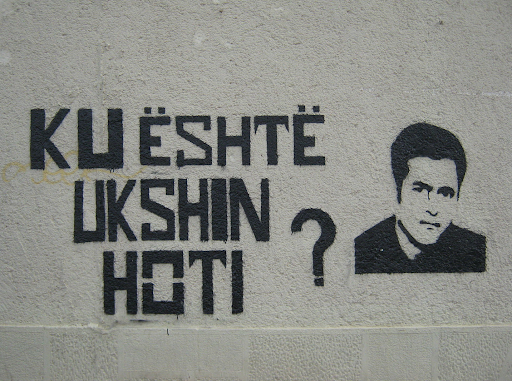
Hoti, transferred days earlier, was not present for the massacre; he was now in absentia, disappeared without a trace. As of 2026, no arrests have been made and no witnesses formally interviewed by relevant prosecutorial authorities. This is in spite of witness testimony that has become available since the war’s end, and information released in 2020 by the Belgrade Higher Court implicating Serb forces in his gruesome alleged murder. 27 years later, one of the brightest philosophical minds molded in the Albanian intellectual tradition remains a phantom. If deceased, he has not been afforded the dignity of the proper burial, necessary for honoring his unique contribution. And so, the question persists on the walls of Kosova as in the minds of his compatriots: where is Ukshin Hoti?

Hoti’s Core Ideas
The following section will include direct quotes from Hoti’s Political Philosophy of the Albanian Cause (1995), which I have translated into English to accurately describe his position. The collection of essays, articles and speeches was composed in the late 1980s and early 1990s under heavy repression. Published in 1995, it was the subject of a lackluster English translation in 1998.
Hoti could have co-opted simple nationalist arguments, basing his thesis on concepts of soil and blood. He could have also taken the route of a Yugoslav-trained political scientist applying standard socialist theory to the Albanian question. To those who have not read him directly, he might appear to be an ordinary liberal democrat citing international law without much additional philosophical depth. Emphatically, Hoti cannot be described by any of these conjectures.
As I have previously observed in this Magazine, his book “seeks to explain the Albanian condition – more specifically Kosova's struggle under Yugoslavia – through moral political responsibility and realism rather than sentiment or myth. Written under the intense repression of Yugoslavia's waning years, Hoti argues that Albanians were politically weakened not only by external domination but also by the evolution of politics into a technical instrument of control.” He rejects both “Machiavellian cynicism and liberal formalism, insisting that politics is simultaneously an art and a moral practice the methods of which shape the fate of nations.” The result is a work of profound philosophical importance.
Politics as Morality and Emancipation
Hoti’s foundational argument is that political language in Kosova had been deliberately and systemically corrupted by those in positions of authority. This meant both ethnic Serb politicians and the Albanians who supported them. Hoti put forth that modern political engagement had degenerated into “instrumental reason” that did not serve truth but domination. The transformation of science and politics as tools of power was not, for Hoti, an accident but a structural feature of modernity, stating that “technical rationality has dissolved into the rationality of domination over nature and people. This aspect of politics and science could be called the cynicism of intellect when it is forced to function instrumentally for domination rather than liberation.”
The Gulf War served as a concrete contemporary illustration: American political and military calculation was reduced to the preparation of “16,000 body bags at the war’s outset” while the Iraqi leadership similarly calculated “acceptable losses.” Both belligerents knew the human consequences and proceeded anyway. This was “the calculative intellect of war — its most cynical expression.” Truth, in such a system, is not discovered but rather manufactured, or as Hoti describes, “produced during the process of cognition.”
Take the Serbian Academy of Sciences’ memorandum from the early 1980s, which constructed a narrative of Serb victimhood within Yugoslavia. To Hoti, this exemplified the “production of a ‘scientific truth’ to enable another truth – the reordering of national relations in Serbia's favor and to the detriment of Albanians. Political intellect was thus placed in the service of particular national interests rather than optimal solutions for all Yugoslav peoples.”
Hoti asserted that political science held an emancipatory obligation against such debasement. As he saw it, the discipline “must reveal contradictions between individual needs and the existing state order and uncover factors that prevent individual awareness of those needs.” In this view, truth does not occupy a neutral position but must rather be framed to ask whose interests it serves, and whether it is directed for the purpose of liberation or domination.
The Nation and The State
One of the arguments developed at length in the book concerns the relationship between the nation and state in Western political theory. Particular attention is paid to what this means for the Albanians of Kosova, a people separated from the official nation-state to their southwest. Hoti masterfully engages with international relations theorists of the West such as Hans Morgenthau, A. F. K. Organski, John G. Stoessinger and Joseph Frankel. These thinkers tended to equate the concept of nation almost entirely with that of state, treating national identity as a function of sovereign political territory rather than ethnic or historical continuity.
Hoti rejected their premises, recognizing what they implied for Albanian politics; he explained that if “Albanians in Yugoslavia would be only a ‘nationality’... understood as Yugoslavs,” their national struggle would be reduced to “a struggle for a larger share of power, but not as a struggle to separate from an already established power.” In other words, by excluding the Albanians from the definition of nation and rather classifying them as a minority within an already defined territory and governing authority, these thinkers delegitimized Albanian self-determination before the argument had even begun. The political consequences of such framing are both self-evident and destructive.
Hoti instead argued that Albanian claims were rooted not in ethnic particularisms, but in the same universal principles that justified any nation’s self-determination. He noted Organski’s assertion that the only quality all members of a nation share is “that they are all under the jurisdiction of the same government.” This definition fails to explain, among others, the case of the Albanians, who lived under four governments while remaining a single people by every other measure. Organski’s framework fails to accommodate this reality because it was developed to justify the status quo of European statehood without addressing the reality of the nations separated in the process.
Hoti drew upon thinkers like Pierre Renouvin and Jean-Baptiste Duroselle to develop a sharp, French-inflected critique. Within their structural perspective, he asks whether “the superior interests of the state, so often invoked, except in rare cases, are merely a way of masking far less noble and, in any case, particular interests?” He argued that the language of universal national interest too often served as a cover for the specific interests of the dominant, most populous nation within a multiethnic state – which precisely described Serbian hegemony in Yugoslavia.

Hoti’s Critique of Marxism
It is in his engagement with Marxism that Hoti shows some of his most original and carefully reasoned thinking. He begins from a position of genuine intellectual respect for the Marxist tradition as a theoretical enterprise. Hoti grants, one could argue too generously, that Marxist theory correctly diagnosed the relationship between class, power and ideology. This is a claim that deserves more skepticism than he was willing to apply.
Marxism’s reduction of power to class interests, and of ideology to economic superstructure, remains one of its most persistent analytical blind spots, in large part because class reductionism fails to adequately illustrate national persistence. We can observe Albanian identity supersede class lines and the phenomenon cannot be sufficiently explained on an economic basis. Marxism’s inability to consider ethnic, religious or civilizational sources of power or conflict hampers it from describing why Yugoslav workers of different ethnicities clashed, or why the Yugoslav regime built in Marxism’s name manufactured positions that served the interests of ethnic Serbs.
Hoti’s reliance on the Frankfurt School – more specifically the theorists Max Horkheimer and Theodor W. Adorno – as analytical tools is also not without its tensions. The Frankfurt School, for all its penetrating critique of bourgeois rationality, remained in its deeper commitments a product of the Marxist tradition it claimed to transcend. Its proponents essentially substituted cultural critique for class analysis while retaining the same fundamental suspicion of liberal institutions and market society that limited the effectiveness of Western Marxism in political action. Hoti draws on the School’s diagnostic ability while largely sidelining its prescriptive and other notable failures.
One may reasonably ask whether a framework unable to produce a coherent account of how free societies ought to be organized is the most reliable lens through which to develop a philosophy aimed at national liberation. Nevertheless, his critique of Orthodox Marxism operates on several distinct levels. Firstly, Hoti strongly argues that the Soviet Union did not utilize Marxism to liberate humanity from imperialism. Rather, the superpower used Marxism to compete with Western imperial powers on the same terms, only under a different banner. While cloaked in revolutionary language, Soviet expansion often reproduced the geopolitical logic of the old Russian Empire it intended to replace. He states vehemently that the “Russians did not fight imperialism to eradicate exploitation but to equal it. Socialism was not considered a goal in itself, nor for the benefit of humanity, but only as an instrument for strengthening the vital interests of the Russian nation merged with the vital interests of the Soviet state.”
Soviet “internationalism” was in practice a mechanism for Russian national expansion under the guise of class solidarity. As Hoti puts it, the Soviet Union was “a Russian proletarian empire on a planetary scale, which was precisely the opposite of the Anglo-Saxon dream: a bourgeois Anglo-Saxon empire with English supremacy.” The two systems fundamentally sought global domination and differed only in rhetoric.
Within the multinational Soviet state, this translated into a systematic policy of assimilation under the guise of socialist construction. The goal was the formation of a “Soviet nation/state with a single language – Russian – initially as a lingua franca, and later as the sole language for all members of all Soviet nations and nationalities.” This was the antithesis of the voluntary blending of peoples that Soviet theory proclaimed; forced assimilation accelerated by centralized power and administered through the discourse of class ideology.
Hoti’s theoretical critique argues that the issue did not lie in the Soviets’ simple betrayal of Marxist theory. Rather, he asserts that once Marxist theory became a governing ideology, rather than merely a revolutionary critique, it transformed into what it set out to overthrow. He explains: “at the moment when Marxism in the USSR and in the countries of real socialism ... had necessarily transformed into the ruling theory of a given society, its revolutionary nature had to be reduced to the component of socialist construction ... if it remained only as a theory of power, as happened, it would turn into a theory of the political status quo.” It eventually shared the historical fate of many once-revolutionary systems of thought – such as Christianity and Islam – whose ethical and social challenges to existing authority were gradually institutionalized and even harnessed in service of empire.
Most directly relevant to the Albanian case, Hoti tackles the Marxist prioritization of class over nation, rooted in the doctrine that the proletariat’s class interests must take precedence over national ones in the construction of socialism. He acknowledges that the original Marxist argument was internally coherent, writing that “the proletariat as a subject – bearer of the revolution – was the same and had the same goal everywhere: the overthrow of the bourgeoisie.” Crucially though, “the proletariat could only fulfill this function as the class of its own nation.” Constituting itself as the revolutionary class did not mean relativizing national interests or subordinating them to an abstract internationalism; it meant realizing those national interests through the common struggle of the working classes of all nations, in parallel, not in a hierarchy dominated by Russian proletariat leadership.
Soviet attempts to speak for internationalism while administering Russian national supremacy therefore represented an abandonment not only of Marxist theory but also the peoples it claimed to liberate. For Albanians specifically, this meant that the Yugoslav Marxist standard, which placed class above nation and dissolved Albanians’ claims into the category of nationality, served precisely the same function as the Western notion that folded Albanian national belonging into Yugoslav citizenship. Both viewpoints denied the Albanian nation its political existence; the West through the language of liberal state sovereignty, the Marxist camp through socialist internationalism. This produced the same result for Albanians, subjected to political illegitimacy under a framework that served the interests of the federal state’s dominant nation.
Marxist classifications of interests, though “a contribution to political thought … do not justify subordinating national interests to class interests.” The Albanian nation exists and carries with it real historical continuity in a recognizable territory. Therefore, it possesses all the attributes of a national community. Any theoretical framework – be it liberal, Marxist or otherwise – that defines it out of political existence falls short.

Beyond Procedural Democracy and Toward Authenticity
Hoti’s most original political concept is what he called authentic democracy. Through this development, Hoti sharply diverged from the liberal formalism of Western theory and the later procedural emptiness of post-communist transition politics. His critique of formal democracy was prescient, emphasizing that “there can be no fundamental human freedom without ethnic freedom. Civil rights do not negate the rights that structure ethnic freedom. In this sense, democracy presupposes patriotism, and patriotism is the expression of democracy insofar as it allows the realization of the freedom of freedoms – of individuals and ethnic collectivities alike.”
Hoti was not urging a retreat into ethnic chauvinism. In fact, it was an insistence that the liberal promise of individual liberty was empty if it did come with a guarantee of the necessary collective conditions, namely ethnic and cultural freedoms, within which individuals could truly practice that freedom. To Hoti, a society which granted civil rights on paper while denying the rights of a nation in practice was not an authentic democracy but rather its simulation. Notably, he made this point before the era of post-communist transition politics, rendering it especially far-sighted.
He was equally critical of the emerging post-communist Albanian political class, noting that “some seem to believe that democracy is their private property.” Hoti’s concept of authentic democracy required not only pluralistic institutions but genuine popular participation and the subordination of political methods to moral standards. Ironically, Hoti’s conditions and criteria are ones that very few existing democracies – post-independence Kosova included – fully meet. He also presented an important demand that went beyond both Western liberalism and Soviet socialism: that pluralistic systems remain genuinely inclusive of labor. He writes: “what kind of political pluralism would it be if it did not allow their representatives free expression of opinion and trade union struggle in defense of working-class interests?” Democracy meant not the periodic consent of workers to distant political elites, but legitimate and ongoing working-class representation.
The Albanian Inferiority Complex
One of Hoti’s most uncomfortable arguments – as it turns the eye of critique on his own people rather than solely their oppressors – concerns what he identified as the Albanian inferiority complex. He asserted that the ethnic group had internalized a set of attitudes toward their capacity for political agency that systematically weakened their performance in this crucial field. This complex manifested as passivity and dependence on the goodwill of foreign powers. Within the Albanian people, Hoti believed there to be a desire, even an expectation, that outsiders solve their political problems.
He pointedly described this as “a degradation and falsification of Gandhism” – a passive resistance that, unlike Mahatma Gandhi’s influential satyagraha, stripped itself of the moral force and strategic coherence that provided the original its effectiveness. In this view, Rugova and his Democratic League practiced a sort of “silent resistance that loses personality” which would ultimately prove ineffective.
The cure to this inferiority complex does not lie in the reassertion of ethnic pride but rather the development of political maturity. This included a refusal to allow the Albanian cause to be instrumentalized by external powers in the service of interests that were not Albanian. In Hoti’s words, “instrumentalization, by anyone and of any kind, has never historically been done for the good of peoples, but only for the short-term benefit of their nomenclatures, internal or external.”
This critique of both passive resistance and foreign exploitation constituted the most distinctive pillar of Hoti’s nationalism. It required more from Albanians, combining a love for the ethnos with rigorous self-criticism that seem to have grown ever rarer.
Morality and its Methods
Throughout his work, Hoti rejects the Machiavellian separation of political methods from ethics. He contends not merely that immoral methods are wrong, but that they are strategically self-defeating and thus corrupt the goal itself. He concretely illustrated this in the context of Kosova, where Serbian political practices had “a negative connotation for Albanians, but for Serbs, regardless of short-term advantages, it qualifies them only as good manipulators for short-term goals but is contrary to long-term interests, such as friendship with Albanians.” This concept is related to one of the book’s best-known sentences: “A Serbia which holds Kosova in bondage is not itself free.” It must be noted that there are parallels between the framework Hoti developed in the Albanian context and post-colonial theory, developed in the decades prior to his work. Most relevant is Aimé Césaire's Discourse on Colonialism, which includes the influential concept of the boomerang effect, by which “colonization … dehumanizes even the most civilized man; that colonial activity … which is based on contempt for the native and justified by that contempt, inevitably tends to change … the colonizer, who in order to ease his conscience gets into the habit of seeing the other man as an animal accustoms himself to treating him like an animal, and tends objectively to transform himself into an animal.”
Hoti argues that the political maneuvers of Serb politicians had purchased tactical advantages at the cost of durable relationships with ethnic Albanians and legitimate, recognized authority. It remains debatable, however, to what extent Kosova’s Albanians would have accepted Serb dominance, even in a more humane form, considering the circumstances around the region’s annexation by Yugoslavia at the end of World War II and many other historical factors.
This is how Hoti described the deeper structure behind his ethics: “A reasonable goal from the perspective of state logic – maintaining public order – cannot justify immoral methods like poisoning children. Such an act not only is immoral, but also automatically calls into question the character of the goal itself.” The example he cites to demonstrate that political methods are not immune to morality is the poisoning of ethnic Albanian students throughout Kosova by the Yugoslav state in early 1990. When deployed, such tactics reveal the character of the structures which utilize them.

Hoti and Vetëvendosje: A Critical Assessment
The Self-Determination Movement (Levizja Vetëvendosje, otherwise simply Vetëvendosje or LVV) is the current governing party in the Republic of Kosova, also holding significant sway in the diaspora. With Prime Minister Albin Kurti at its helm, the movement has consciously positioned itself as the intellectual successor to Hoti more often than any other political movement. This claimed inheritance has never been limited to symbolic gestures or annual commemorations. Rather, it has openly been articulated by the party’s leadership as a claim of substantive continuity: of political method, democratic vision and national purpose.
Kurti has repeatedly described Hoti not merely as a historical figure in the struggle for Albanian liberation but as an intellectual reference point for the party and the young republic. At first glance, the claim to inheritance is not difficult to sustain. The early ideological formation of Vetëvendosje contains clear points of convergence with Hoti’s political thought. Both the movement and Hoti placed self-determination at the center of political legitimacy – hence the party’s name – while strongly rejecting political passivity and including overlapping elements of leftist thought.
Yet if we examine the movement’s transition from a collection of opposition voices to governance, the relationship to Hoti becomes much more complex. Hoti’s political philosophy was never simply a defense of national rights. Instead, it presented a critique of the processes that unfold when emancipatory language takes the shape of institutional routine. In an aforementioned quote, Hoti explicitly warns that when revolutionary doctrines are brought to power, they risk becoming “theory of the political status quo” — thus preserving the institutions they initially aimed to dismantle.
That warning acquires particular relevance in light of Vetëvendosje’s own evolution in government, beginning in earnest in 2021. Independent governance assessments, including the most recent Kosova report drafted by the Bertelsmann Stiftung foundation, have noted increasing executive command in legislative initiatives, limited parliamentary scrutiny of government-driven legislation and recurring controversies around the independence of public broadcasting institutions. None of these dynamics are unique to Vetëvendosje, nor do they inherently signal major democratic regression. They do, however, raise a legitimate theoretical question: can a movement founded upon the critique of formalistic and procedural democracy preserve that element after becoming the institutions it once challenged?
However, the most uncomfortable tension concerns the fate of Hoti himself. Nearly three decades after his disappearance on May 16, 1999, the case remains unsolved and predicated on hearsay, lacking convictions or even a definitive institutional investigation. Of course, it would be less than analytically serious to attribute this failure to a single administration. Yet, the disjunction between symbolism and reality remains difficult to ignore: the political movement that most often invokes Hoti’s memory to establish its ethics and intellectual foundation now governs a state that has yet to deliver justice regarding his fate. This does not by itself invalidate the party’s claim to his legacy, but it certainly calls to mind important questions of political responsibility.
An honest conclusion leads us to an understanding of Vetëvendosje’s claims not as fraudulent, but incomplete. There is certainly validity in their claimed continuity; yet the tensions introduced by state power and the results it delivers are too important to ignore. Hoti remains relevant to Kosova’s contemporary and future politics in part because the mere mention of his name can grant legitimacy to a movement. This is what his daughter Erleta Hoti was referring to when she publicly stated that her father’s name is “mentioned just for political gains by political parties,” a damning indictment of all major movements. However, his son Andin Hoti departed from the Democratic Party of Kosova (PDK) to successfully run for parliament under Vetëvendosje’s slate in 2025. Nevertheless, his name and philosophical position demand that every movement be subject to scrutiny once it acquires power – further amplified if it lays a direct claim to his intellectual legacy.
Legacy and Conclusion
In a passage of his Political Philosophy, Hoti describes what politics must be in its essence. He frames it not as the calculation of power or manufacture of truths but, provokingly, as “theories [that] should serve to clarify the mind,” allowing it to perceive what is just and desirable. Thus, “let … the Republic live.”
The institutional commemoration of Hoti’s legacy in Kosova is extensive. The University of Prizren bears his name, as does the Ministry of Foreign Affairs building in Prishtina, honoring his contribution to Kosova’s diplomatic efforts. Among Kosova Albanians, his memory continues to inspire, leading some 13,000 residents of Rahovec to sign a petition demanding that the authorities investigate his disappearance. That his people have not forgotten is also exemplified by the graffiti marking the small republic’s urban walls, with Hoti’s eyes and the stark black letters interrogating onlookers about the fate of this great mind.
Yet there remains a debt on the part of those who invoke his name in the present day. It is telling that, though Hoti’s memory has remained strong, there is a titanic gap between the sentiments his image induces and the comprehension of his philosophy. It is an ethics and politics that is gradually falling victim to neglect. When neglect turns to apathy, one has to wonder whether it is befitting to even invoke his name. To truly inherit Hoti is not to include a striking quote in a speech, name a building or claim his mantle come election season. It is to act with the same passion that he did in thinking rigorously and holding politics to moral account.
The man of Anadrini was ultimately a man of Albania. This is best exemplified by Hoti’s immortal and most recognizable words: “Out of an incomplete Albania, create a complete one – achieve it or perish!” It is not simply a message of national motivation, but a call for grit and determination in the face of any odds, from a man who faced unspeakable hardship for his beliefs. Hoti calls on his compatriots to advance as one – not “materially” finishing Albania or Kosova, or any state but fostering a deeper spirit of intellectualism and dedication amongst the ethnos he sacrificed so much for.
And so, where is Ukshin Hoti? He remains among us all, if we choose to accept the obligation.
To invoke Ukshin Hoti while accepting silence regarding his disappearance is to commemorate the man while neglecting the obligation he left behind. For this reason, Arbanon Magazine calls upon the institutions of the Republics of Kosova and Albania, international investigative bodies, former state officials, witnesses and all persons with relevant knowledge to assist in concluding this most painful chapter of his memory. History accepts no alibis, as Hoti eloquently taught us.

Valton Vuçitërna is a fourth-year student studying Finance at Michigan State University's Eli Broad College of Business, serving as the Deputy Chief Editor of Arbanon Magazine. Valton was born and raised in Grand Rapids, Michigan to parents from Kosova. He is the founder of The Anadrini Project, a database designed to record the histories and genetics of families in Kosova's region of Anadrini, as well as the history of the town of Rahovec. He is interested in European history and the cultural heritage of the Albanian people.



Comments