
Preserving Identity Across Oceans: The History of Albanians in Australia
Author: Bleron Zajmi

Albanians marching in a post-World War II celebration march on Swanston Street, Melbourne, c. late 1940s. Courtesy of Fikri Taip as part of the collection of the ‘Kurbet’ exhibit at the Victoria Museum, which was organized through the collaborative efforts of the Immigration Museum of Victoria, the Australian Albanian Women’s Association, and numerous Albanian Australian individuals from the local community. The exhibition was held between 19 November 2007 - 24 February 2008.
Australia is often described as a multicultural nation shaped by migration. Nicknamed the ‘Lucky Country’, many peoples from across the globe have sought better lives for themselves and their families on its shores since it was first colonized by the British in 1788. These migrants have contributed to the country’s economic and societal development, and they have all participated in the evolution of a national identity that is now proudly shared by millions of “Aussies” from a diverse range of backgrounds.
Conversely, the Albanians have historically been characterized by outward migration, seeking alternatives to the constant conflict and socioeconomic struggles that have plagued their homeland for centuries. This search for a life of peace and prosperity has taken them to every corner of the world, the Lucky Country included. However, like many diaspora communities in Australia, the Albanian community did not emerge from a single migration event, but rather from several movements originating from different regions that occurred across historical periods.
Albanian immigration to Australia is therefore a layered narrative that can be broadly divided into three chronological groups: arrivals from Albania itself prior to the Second World War, others from ethnically Albanian territories in Yugoslavia in the post-war period, and finally recent arrivals from Albania and Kosova in the period following the downfall of Albanian communism and the Kosova War.
Early Albanian Migration

A map of Australia and its states. Important centres of Albanian settlement are highlighted in red. Some of the toponyms mentioned in this article may seem quite foreign to non-Australian English speakers, but their uniqueness comes from their Indigenous Australian etymological roots.
The first recorded Albanian migrant in Australia was a man named Naum Konxha, who moved to Brisbane, Queensland with his English wife in 1885. His arrival was followed by a handful of Albanian migrants who reached Australia at the beginning of the 20th century. The first full-fledged wave of Albanian migration to Australia occurred during the 1920s – particularly after 1924, when the United States placed quota restrictions on Southern European migration, forcing hopeful travelers to search for a new home elsewhere. Most Albanian migrants during this period were young men from rural and less formally educated backgrounds who were continuing a tradition known as kurbet (Tosk) or gurbet (Gheg) (from the Turkish ‘gurbet’, meaning “out in the world”). The practice saw young men leave their homes for several months or even years to earn money for their families. These kurbetxhinj usually intended to return home with their savings, but many ended up permanently settling in the country.
The Albanians initially arrived in York and Morana in Western Australia after disembarking at Fremantle Harbour in Perth. There, they worked principally as land clearers, turning bushland into productive farmland, or as charcoal burners, market gardeners and woodcutters. The Great Depression of 1929 took a toll on the working class, and the lack of employment forced many Australian men to turn to the goldfields to seek their fortune. As such, tensions rose between the local Anglo-Australians and the Southern European migrants over employment in the mines. After the murder of an Anglo-Australian on Australia Day weekend in 1934, riots seized Kalgoorlie and Boulder, situated elsewhere in the vast expanse of Western Australia, and resulted in the looting and burning of some Southern European migrants’ residences.

A picture of Mehmet Osman Trungu and Ylmi Topi, who worked felling scrub in Western Australia, c. 1925. Courtesy of Edmond Pere as part of the ‘Kurbet’ exhibit at the Victoria Museum.
The combined effect of the Depression and the hostility of Anglo-Australians would encourage Albanian migrants to head eastwards during the 1930s into rural settlements, where they would find employment in agriculture. They settled in places such as Shepparton and the Werribee district of Melbourne in Victoria. A number of Albanians also moved to Mareeba and Brisbane in Queensland to work on tobacco, sugar, maize and cotton farms which operated year-round, whilst a few migrants remained in Western Australia, namely in York. Overall, more than 1,000 Albanians migrated to Australia over the course of the 1920s, with 1928 seeing the most arrivals, but a few hundred had already left Australia prior to the 1933 census.
This wave is also one of the earliest instances of Muslim settlement in Australia, as an estimated 60% of the Albanian migrants were Muslims, with the remainder being Orthodox Christians. The Muslims, hailing primarily from rural areas of Korça, Kolonja, Bilisht and Pogradec in southeastern Albania, were more heavily involved in rural agricultural labor. In contrast, the Orthodox Christians, who originated primarily from Korça and Gjirokastra, had already been more engaged in urban trades in Albania and therefore settled in towns once they arrived in Australia. Indeed, the southeast was the primary place of origin for most Albanian migrants who made their way to distant lands during this period of time, due to the region’s strong connections with commercial and educational networks. Even today, it remains a running joke in Albania that, in order to win the US Diversity Visa Lottery, one must be a Korçar!
Particularly notable is the Albanian community of Shepparton, Victoria, which would become the home of Australia’s best-established Albanian community. Approximately 300-500 Albanians lived in and around Shepparton in the late 1930s, roughly evenly divided between Muslims and Orthodox Christians. Some of the Orthodox Albanians identified as Greeks, a phenomenon tied to the assimilatory pressures of Hellenizing policies promoted by the Greek Orthodox Church and its clergy within Albanian Orthodox communities.
Albanians were first recorded in the Australian census in 1933, numbering 770 individuals (766 males and 4 females), with most living in the state of Queensland. This number had doubled by 1947 as many of these migrants were joined by their families, with most now living in the state of Victoria, which has retained the largest Albanian-Australian population since. The demographic shift to Victoria was driven by natural population growth in the state, as well as the discrimination faced by Albanians in northern Queensland during World War II, which prompted many to relocate to the more welcoming environment of Victoria. It should be noted that Albanians typically entered wedlock within their own community: men who wished to marry would return to Albania to find a wife or otherwise send money for the marriage and to facilitate the bride-to-be’s journey to Australia. In fact, only one documented instance of a mixed marriage during this period has been found in Australian state archives.

Left: Suleman and Nezi Ymer and their children living on land they bought with lottery winnings in Biloela, Queensland, 1928. Courtesy of Hanife Ymer as part of the ‘Kurbet’ exhibit at the Victoria Museum. Right: A picture of Zymbyle and Selime Mehmet on their family’s cotton farm in Biloela, Queensland, 1935. The Mehmet family eventually moved to Shepparton, Victoria. Courtesy of Mary Mehmet as part of the ‘Kurbet’ exhibit at the Victoria Museum.
World War II
A few months prior to the onset of the Second World War, Italy launched an invasion of Albania. Under the rule of Benito Mussolini, the Italians had aligned themselves with the Axis powers and the Italian puppet government in Albania subsequently declared war on the Allies the following year. In Shepparton, rumors circulated that Mussolini’s government intended to impose Italian citizenship on Albanians living abroad. These fears intensified in May 1939, when the proprietor of an Albanian club reported that he was approached by an individual linked to the Italian consulate in Melbourne, the capital of the state of Victoria. The man was asked to host a meeting at which the consul would administer an oath of allegiance, effectively registering local Albanians as Italian citizens under the threat that those who refused would face difficulties obtaining passports to re-enter Albania. Alarmed by the situation, members of the Albanian community raised their concerns with local authorities, who in turn referred the matter to the federal government in Canberra. The Interior Ministry ultimately declined to intervene, though it suggested that, while Albanians in Australia could not be directly punished, their relatives in Albania might face repercussions, lending further weight to the perceived pressure.
Although the proposed visit by the Italian consul never materialized, tensions within the district continued to escalate and were widely reported in the press. When the local Italian community organized a hospital fundraiser shortly after the initial incident, some Albanians mistakenly believed it to be the anticipated citizenship ceremony and gathered in protest. The demonstration promptly drew the attention of both local and national media, with members of the Albanian community taking advantage of the moment to publicly affirm their loyalty to Australia. One community member declared to the press that Albanians sought “to become Australians, not Italians,” while another publicly denounced Mussolini, even destroying his image in an act of protest whilst complaining that the Italian invasion had resulted in the murder of his brother. A contemporary newspaper interviewed the aforementioned proprietor of the Albanian club, who noted a surge in applications for British naturalization among Albanians in Shepparton whilst claiming that others abandoned plans to return to Albania altogether. We speak of ‘British naturalization’ because Australian citizens were classified as British subjects until the Nationality and Citizenship Act of 1984, though Australian citizenship was previously created in the Nationality and Citizenship Act of 1948.
Despite their demonstrated loyalty to Australia, Albanians were classified as “enemy aliens” as a consequence of the Italian occupation. This meant that they were required to register with the state and faced the possibility of internment. In particular, Albanians in northern Queensland were interned in camps such as Monto and consigned to work specific jobs assigned to “enemy aliens,” such as farming and road construction. By contrast, Albanians who were naturalized British subjects were not compelled to undertake such labor. Advisory committees were established in each state to hear appeals for those who were not naturalised subjects; since most Albanians in Shepparton were engaged in agriculture, which is a primary production, they were exempt from internment and compulsory service. In Western Australia, only two Albanians were registered, but both were granted exemption due to their employment as market gardeners. Nonetheless, under the status of “enemy aliens,” Albanians were subject to a firearm ban and travel restrictions, requiring them to obtain permission from the local police before leaving the area. These rules were strictly upheld, with an Albanian farmer from Shepparton facing a fine for travelling to Melbourne to sell his fruit without first obtaining a police permit.

Top: A group of Albanians at the Monto internment camp for “enemy aliens” in Queensland, c. 1940s. Courtesy of Hanife Ymer as part of the collection of the ‘Kurbet’ exhibit at the Victoria Museum. Bottom: Albanian men interned as “enemy aliens” at the Monto internment camp in Queensland, early 1940s. Courtesy of Hanife Ymer as part of the collection of the ‘Kurbet’ exhibit at the Victoria Museum.
Despite their designation, Albanian-Australians contributed to the Australian war effort. Most notably, more than thirty Albanian-born migrants enlisted in the Australian army. These men – at least three-fourths of whom came from Muslim families – served in both domestic support roles and in active combat across the Pacific. Two of these men died during active duty – Kurt Ali Raman from the village of Mançurisht in Korça, who was killed in action in Papua New Guinea, and Muharem Ali Kolayasi from Korça’s Sul village, who died as a Japanese Prisoner of War (POW) in Ambon, one of Indonesia’s Maluku Islands.
Albanian-Australians also played an active role on the home front. Community organizations – particularly those in Shepparton – raised funds for the war effort, the Red Cross and local institutions such as the Mooroopna Hospital, often acting collectively as an ethnic bloc. In 1943, the establishment of the Free Albanian Association formalized these efforts, with a clear emphasis on fostering loyalty to Australia, encouraging the study of English, and assisting Albanians’ integration as Australian citizens. Members of the community also took pride in highlighting Albanian participation in the Australian military. These contributions were publicly recognized at the time and continued into the post-war period, with Albanian organizations participating in Anzac Day commemorations, which honor Australian and New Zealander troops who lost their lives in several conflicts, and upholding their veterans as symbols of a deep commitment to their host society.

Left: A picture of Mustafa Sheriff, who served in Papua New Guinea after enlisting in the Royal Australian Air Force on August 18, 1942. Courtesy of Sandra Harris as part of the ‘Kurbet’ exhibit at the Victoria Museum. Right: A picture of Hodo Hamit in Australian military uniform. Hamit served during WWII with the Australian Military Forces in Darwin, the capital of Australia’s Northern Territory. Courtesy of Victor Hamit as part of the ‘Kurbet’ exhibit at the Victoria Museum.
Post-War Life
In 1944, at the close of the Second World War, the Communist Partisans took control of Albania following the departure of occupying Nazi German troops. Albanians in Australia were subsequently reclassified from “enemy aliens” to “friendly aliens.” In the years following, approximately 400 Albanians – among whom were anti-communist refugees, including members of the National Front (Balli Kombëtar) – arrived in Australia. Many of them further reinforced the growing Albanian presence in Shepparton. The town recorded 227 Muslim inhabitants in the 1947 census, almost all of whom are assumed to have been Albanian. Indeed, the Albanians formed the foundation of Shepparton’s Muslim community, which persists to this day; a Sunni Albanian mosque was built in Shepparton in 1956, making it the first such institution in the state of Victoria.
The mosque was founded following the 1955 establishment of the Shepparton Albanian Moslem Society, which was influenced by the broader tensions of the Cold War era. It was believed that a religious institution would be less likely to attract communist sympathizers than a purely ethnic organisation during a period of heightened suspicions towards Albanians. Although Albanian-Australians initially supported Enver Hoxha for having fought against the Axis powers, most of the community quickly united in opposition towards the communist regime he instated. Political tensions were not entirely absent; one notable incident rocked Shepparton in 1953, when an individual identified as a “Royalist” (a Zogist; a supporter of the exiled and self-proclaimed Albanian King Ahmet Zog) shot a member of the Balli Kombëtar who had recently moved to Australia.
Hoxhaist Albania became an increasingly isolated communist state until the dictator’s death in 1985 and the subsequent fall of communism in 1990. Due to the sealed borders, some kurbetxhinj who had returned to Albania hoping to collect their families and return to Australia found themselves trapped in the country. Those who remained in Australia were separated from their families and in some cases never reunited. Consequently, the next wave of migration would hail from Albanian-speaking territories occupied by the former Yugoslavia, which systematically discriminated and often encouraged the exodus of its Albanian citizens.
Many migrant families arrived from what is now North Macedonia, particularly the regions around the Lakes Ohër (Ohrid) and Prespa. A smaller number of migrant families also arrived from what is now Kosova and Montenegro, especially from the region of Ulqin. The new migrants settled primarily in urban locations within Victoria and the neighboring state of New South Wales. Of particular note are the communities of Dandenong and Melbourne’s western suburbs, as well as that of Wollongong in the Illawarra coastal region. By the 1976 Australian census, the number of Albanians in Australia had grown to approximately 1,500 individuals.

Top: Albanians marching in a post-World War II celebration on Swanston Street, Melbourne, c. late 1940s. Courtesy of Fikri Taip as part of the ‘Kurbet’ exhibit at the Victoria Museum. Bottom: Community members celebrating Albanian Independence Day at Richmond Town Hall in Melbourne, November 28, 1965. Courtesy of Jennifer Kalaja as part of the ‘Kurbet’ exhibit at the Victoria Museum.
Many of those who came to the Illawarra region worked as industrial laborers in the suburbs and steelworks of Wollongong. The city’s active diaspora community was first home to the ‘Agimi’ (Dawn) association, which was later registered as the Albanian Australian Cultural and Artistic Society ‘Bashkimi’ (Unity) of Illawarra in 1980. The association was founded by Safet Biba, who migrated to Australia from Struga in 1973, and he served as the association’s president for a total of eighteen years up until 1998. The ‘Bashkimi’ association established an Albanian-language school in the same year as its founding, which was also directed by Safet Biba and his wife Sabernaze from the town of Istog (Burim) in Kosova, both of whom worked as teachers prior to migrating to Australia. Supported by the Ethnic Affairs Commission of New South Wales, the school taught local children to speak, read and write in Albanian, with its students also participating in cultural parades and performances throughout the region.
Reflecting on the role of the association, Biba described it as the first of its kind in the Illawarra, emphasising that it served as “a nest for all Albanians to gather and to celebrate.” He further noted that the association played a vital role in preserving identity as it “facilitated the transmission of language, traditions and culture to the Albanian youth.” As Biba concluded, “the fruits of [this] work continue to be felt today,” as many of the school’s students developed out of an inability to speak the language to subsequently communicate and write in their mother tongue with confidence.

Top: Youth from the Albanian Australian Cultural and Artistic Society ‘Bashkimi’ of Illawarra participating in a multicultural parade held in Wollongong in the 1980s. Courtesy of Safet and Sabernaze Biba. Bottom: Youth from the Albanian school of Illawarra reciting poems as part of the November 28th celebrations for Albania’s Independence Day during the 1980s. Their teacher, Safet Biba, is pictured on the right. Courtesy of Safet and Sabernaze Biba, the grandparents of the author of this article.

Above: The poem ‘Agimi’, written by Safet Biba in honor of the Illawarra community, was taught to students at the local Albanian school. Originally recited and relayed by Sherif Sherifi, an Albanian-Australian who attended the school as a child.
Wollongong was not the only Australian city to host an Albanian-language school in this period. Similar institutions also took form in Sydney and Melbourne, enabling the children of migrants to read and write in their language. The very first Albanian-language school in Australia was centered at the Albanian Mosque in Carlton during the 1960s The program's director, Mithat Jusufi from Manastir, now North Macedonia, is therefore considered the first Albanian-language teacher in Australia.
The area of Dandenong in Melbourne is home to another prominent Albanian-Australian community. Beginning in the early 1960s, the Albanian presence has grown to a few thousand, most of whom originated from the surroundings of Manastir and especially the village of Këshavë. In 1970, the Albanians of the region founded a football club called ‘South Dandenong.’ In the 1980s the team also adopted the name ‘Prishtina’ in honor of the protests organized in Kosova’s capital against the anti-Albanian policies of the Yugoslav regime. In 1985, the community – composed primarily of Muslim Albanians – funded and built Dandenong’s first mosque.

Above: A picture of the first Albanian-language school in Australia in 1965, held at the Albanian Mosque in Carlton. The director and teacher of the class, Mithat Jusufi, can be seen on the right side of the image. Courtesy of Jennifer Kalaja as part of the ‘Kurbet’ exhibit at the Victoria Museum.
Fall of Communism and the Kosova War
With the fall of communism in Albania in 1990 and the subsequent migration of several hundreds of thousands in the following decades to all the world, Shepparton’s Albanian community was replenished by yet another wave of migrants. A hundred families from Korça were sponsored for work visas by the Shepparton community, and some of the descendants of migrants who had been trapped in Albania several decades prior also arrived, having regained their eligibility for Australian citizenship. An Australian Albanian Women's Association was founded towards the beginning of the decade in 1993.
By 1996, there were 6,212 Australians who spoke Albanian at home, an increase of approximately one-quarter from the 1986 census. The total number of Albanian speakers was significantly higher than the number of Albanian migrants who were born overseas, of whom 1,299 were born in present-day North Macedonia, 653 in Albania and only 60 in what is now Kosova, Serbia and Montenegro. The figure of Albanian speakers who had a poor or no grasp of English stood at 16%. Albanian was being utilized across a significant age range, reflecting the desire of the community to keep their culture alive.
By this point, the vast majority of Albanian families in Australia – roughly 80% – were Muslim, with significantly smaller numbers of both Catholics and Orthodox Christians; this remains the case today. Aside from the mosques in Shepparton and Dandenong, Albanian Muslims also built houses of worship in Mareeba (Queensland), Carlton North and Reservoir in Melbourne (Victoria), and more recently, Smithfield in Sydney (New South Wales). The Albanian Australian Islamic Society (AAIS), founded in 1963 in Melbourne, is centered at the Albanian Mosque in Carlton and functions to this day with nearly 1,000 supporting families.
Catholics from Northern Albania, Kosova and Albanian-inhabited territories in the Great Highlands (Malësia e Madhe), part of which now falls in Montenegro, have also embedded themselves within the community, particularly in the cities of Adelaide, Melbourne and Sydney. They founded the Albanian Catholic Society in Melbourne in 1974, regularly hosting festivities for the community. In fact, during a trip to Australia in the year of the society’s founding, Nëne Tereza, also known as Mother Teresa or Saint Teresa of Calcutta, met with members of the Albanian Catholic Society in Melbourne.

Top: A picture of the Albanian Mosque’s official opening in Carlton, 1969. Courtesy of Ali Ymer as part of the ‘Kurbet’ exhibit at the Victoria Museum. Bottom: A picture of the meeting between Nënë Tereza and the Albanian Catholic Society in Fitzroy, Melbourne, 1974. Courtesy of Lek Ndreka and photographed by D. Loram as part of the ‘Kurbet’ exhibit at the Victoria Museum.
The Kosova War and the ethnic cleansing campaign at the heart of the conflict led to a mass exodus of Albanian civilians and a refugee crisis, with Australia accepting 4,000 people on temporary protection visas. These refugees did not only include Albanians from Kosova, but also Albanians from the occupied Presheva Valley in Serbia and from adjacent ethnically Albanian territories in North Macedonia. These refugees were housed in military-style accommodation facilities and provided significant support by the longstanding Albanian-Australian community, particularly with interpretation services between Australian workers and the refugees themselves. Although most returned to Kosova at the end of 2000, some individuals and families remained in Australia and would eventually become Australian citizens.
During this time, Erik Lloga – an Albanian from Ohër who migrated to Australia in 1969 and served as the chairman of the Albanian-Australian Community Association in North Carlton – set himself apart on account of his leadership abilities. As the spokesman for Melbourne’s Albanians, Lloga played an active role as the main interlocutor between Australian authorities and the 1,250 refugees from Kosova then housed in Victoria; he even served as the personal interpreter for then-Prime Minister John Howard. When Australia sent back the majority of the refugees, Lloga accompanied them to aid in their re-settlement, as many had no homes or financial support to return to. He financially supported a number of the returnees and helped connect them with humanitarian agencies, which were inadequately prepared for their repatriation. The Australian government did not provide aid for the returning refugees, resulting in many living in precarious or even destitute conditions. In recognition for his tireless contribution to multicultural affairs and the Albanian community during the Kosova War, Lloga was awarded the Order of Australia medal in 2002.

Above: An image of the 300-year-old handwritten Qur’an from the Silvi Xhami theological school in Ohër, brought to Australia by Erik Lloga’s father, Lutfi Lloga. It was later donated by Erik to the Shepparton Albanian Mosque, the first such Albanian institution in Australia; it now forms part of the Museums Victoria Collection. Image courtesy of Ridvan Ahmet as part of the ‘Kurbet’ exhibit at the Victoria Museum.
The Diaspora Today
Today, Albanian-Australians form a well-established diasporic community that continues to maintain strong connections to its cultural heritage while fully participating in Australian society and contributing to its multicultural environment. Through community associations, religious institutions, cultural events and language schools, Albanian-Australians have sought to preserve their traditions, language and identity across generations.
A total of 19,686 Australians reported having Albanian ancestry in the 2021 Australian census, with 5,109 having been born in Albania and Kosova. More Albanian-descended Australians were certainly born in present-day North Macedonia and Montenegro; however, it is not possible to determine how many of those recorded in the census as being born in those countries are of Albanian background. The state of Victoria remains home to the largest proportion of the Albanian community in Australia, with approximately 4,000 in Dandenong and another 3,000 in Shepparton. Additionally, a total of 10,851 people declared that they spoke Albanian at home, which amounts to a little over half of the total population of Australians with Albanian ancestry.
Albanian community associations can be found in a number of major cities across Australia. These organizations regularly host community gatherings and celebrations, particularly for significant national occasions such as the Albanian and Kosova Independence Days. In addition to these festivities, a few associations have invested in educational programs, including short-lived Albanian-language classes for children; yet these initiatives require both greater institutional and community interest to prove lasting successes. The community in the Illawarra, for example, has not enjoyed a functioning Albanian-language school in decades, while the ‘Bashkimi’ association has remained dormant since 2000. However, its legacy continues to be felt not only within the Albanian-Australian community but also in wider society. In 2018, ‘Bashkimi’ donated over 50,000 Australian dollars accumulated over the years to the Sydney Children’s Hospital in Randwick, where a commemorative plaque now stands in recognition of their generosity.

Top: A photo of the ceremony recognizing the ‘Bashkimi’ association’s donation to Sydney Children’s Hospital Foundation in 2018. On the left-hand side of the picture are Safet and Sabra Biba and on the right-hand side are Sefade and Xhemal Ajdari. Photo courtesy of Ariana Biba. Bottom: The plaque commemorating Bashkimi’s donation, now located on Level 7 of the Bright Alliance Building in Sydney.
The Dandenong community has continued to grow and plays an influential role in the suburban region. Dandenong is now home to the public park ‘Keshava Reserve’ and the ‘Keshave Grove’ road, both of which are named after the village from which most of the community hails in present-day North Macedonia. The two names were granted during the mayoralty of Jim Memeti, a local ethnic Albanian who served six terms in office. Similarly, the city of Greater Shepparton is served by mayor Shane Sali, a member of the local Albanian-Australian community; that office was also previously held by Dinny Adem, another Albanian-Australian.
Albanian heritage is also acknowledged at a prominent, national parliamentary level, albeit in more unexpected ways. Anthony Albanese, the current Australian Prime Minister, whose last name literally translates to “Albanian” in Italian, acknowledged that “somewhere back in my past, there’s no doubt a very direct connection with Albania” at the November 26, 2024 launch of the Parliamentary Friends of Albania group in Canberra, the federal capital. Albanese is a common family name among descendants of the Arbëresh ethnolinguistic community which settled in southern Italy following the Ottoman invasion of Albanian-speaking territories. The Prime Minister’s father, Carlo Albanese, hailed from Barletta in Apulia of southeastern Italy – one of the principal regions of Arbëresh settlement – though father and son did not reconnect until later in life.
Dandenong’s Albanian football team – now known as Dandenong Thunder – won the semi-professional Victorian Premier League back in 2012 and the NPL2 Victorian title in 2017. The club’s home ground holds the name ‘Qamil Rexhepi’ in honor of a prominent member of the club and local community. The Qamil Rexhepi Cup is held every year as a friendly tournament between Albanian-Australian teams. The club grounds also function as a center for community events, supported primarily by local Albanians themselves. The North Sunshine Eagles are another prominent Albanian-Australian team in the Victorian Premier League from the St. Albans suburb of Melbourne. The club was initially founded as Klubi Futbollistik ‘Shqiponja’ (the ‘Eagle Soccer Club’) in Yarraville in 1975 before finding its new home in St. Albans in 1991. Every year, the club hosts the Albanian Cup, a competitive tournament between numerous community teams from across Australia.

Left: The logo of Dandenong Thunder F.C. The Albanian double-headed eagle on a red background functions as the club’s logo, as a homage to the Albanian flag. Right: The logo of North Sunshine Eagles F.C. The logo is also based on the Albanian flag and includes variants of the club’s name in both English and Albanian.
The Shepparton Harvest Festival: A Major Community Event
Shepparton now hosts the annual Albanian Harvest Festival, bringing together Albanians from across Australia for a day showcasing culture, music and cuisine to the wider community. While similar events are held elsewhere, such as the annual festival in Footscray, Victoria, the Shepparton Harvest Festival stands out as the initiative of one of Australia’s oldest and best-established Albanian diasporic communities. Speaking on the festival, Shepparton local Reg Qemal stated that “it is not only a harvest festival, but a festival that brings the whole Albanian community together.”
Qemal, who traces his origins back to Korça, is a prominent member of the Albanian-Australian presence in Shepparton. Having served in the Albanian Moslem Society for over 16 years and as its president for five, he has worked tirelessly to ensure that his community retains and passes on its traditions and culture. Qemal also produced the award-winning documentary Australia My Home: An Albanian Migration in 2021, directed by Albanian-Australian director Dritan Arbana. The film poignantly explores the major waves of Albanian migration to Australia. In an interview with Qemal at the 2026 Shepparton festival, he explained that after being screened across the country and receiving numerous awards, the documentary has since been picked up by SBS Australia and will be broadcast on national television – representing a major success for the Albanian presence in broader Australia society.
Qemal noted that the documentary also contributed to the growth of the Shepparton Harvest Festival, as many Albanians were previously unaware of the long-established community in the region. Reflecting on the festival’s origins, he explained that it “started 27 years ago as an idea by the late Jim Ymer to bring the local Albanian community together to keep our traditions. It has grown into one of the largest Albanian festivals in Australia, and now brings all of our brothers and sisters from around the country to celebrate and maintain our culture. One of the key factors that I have found, even with the Albanians in Shepparton, is that although they've been here for over 100 years, they certainly learned how to assimilate and integrate into the local society whilst maintaining their culture.”
He was particularly emphatic in highlighting the unity of the community, stressing that cultural identity transcends religious differences: “Regardless of religion, we’re Albanians first and we’re all brothers and sisters – and we keep that tradition alive here in Australia”. Some may form certain impressions by the name of the Shepparton Albanian Moslem Society, assuming that it serves only that religious community and excludes those of Christian backgrounds. In reality, it has long functioned as a central institution for the entire community, irrespective of religious affiliation. As discussed earlier, its formation in 1955 was shaped by the political climate of the Cold War, in which the adoption of a religious framework was seen as a way to demonstrate loyalty to Australia and avoid associations with secular communism, rather than as an effort to divide the community along religious lines. It is also important to keep in mind that Muslim Albanians formed a sizable majority among this diaspora. For a deeper background on Albanian religious unity, see our previous article on the matter.
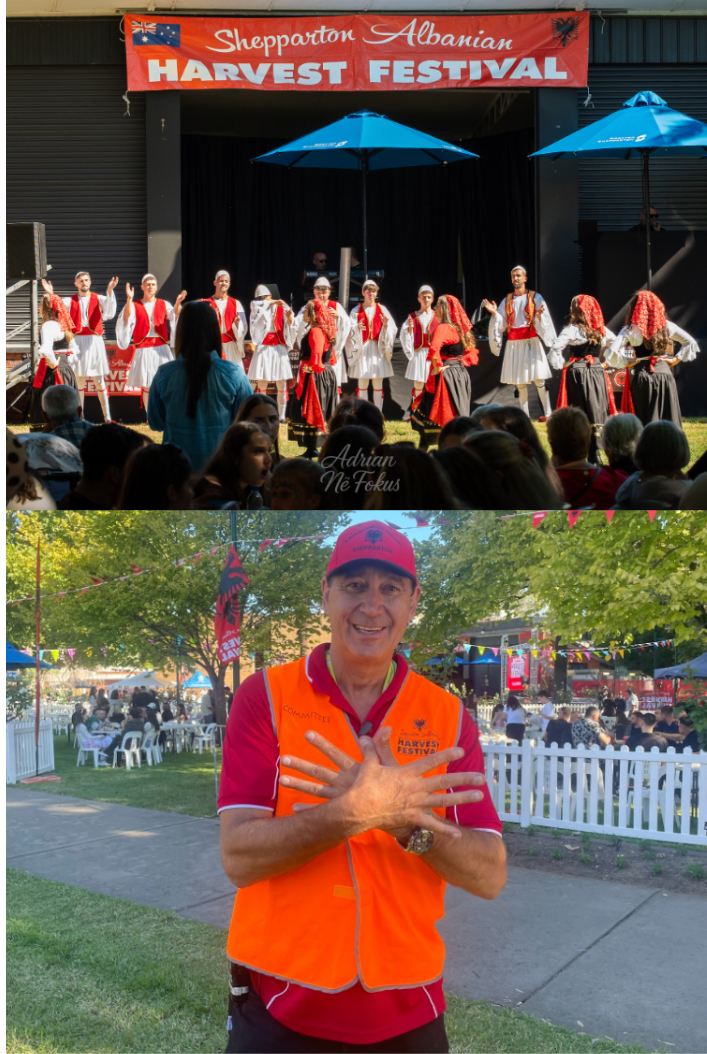
Top: One of the Albanian-Australian traditional dance groups performing at the Shepparton Harvest Festival in 2026. Courtesy of Adrian Në Fokus. Bottom: Albanian-Australian local community leader Reg Qemal at the 2026 Shepparton Harvest Festival, picture courtesy of the author.
Cultural Groups and Events: Eagles Folk Dance and Radio 3ZZZ
One of the standout cultural highlights of this year’s Shepparton Harvest Festival was the performance by the Eagles Folk Dance group, the first Albanian-Australian performing arts school of its kind. The organization was founded on May 26, 2021 by Anisa Dyrmishi alongside her father – fellow choreographer Fatbardh Dyrmishi – as well as the deputy president and assistant choreographer Ermal Fasi. It has since grown into one of the most important cultural organizations in the Albanian-Australian community – and one of the only registered Albanian non-profits in the country. It should be noted that there are also other dance groups, such as Grupi i Vallës Nënë Tereza (the Mother Teresa Traditional Dance Group) in Adelaide which has been active since 2015. Yet Eagles Folk Dance stands out for its scale, organisation, and frequency of activity in recent years.
At its core, Dyrmishi explains what she views as the organization's mission, namely seeking to ensure that they “keep Albanian cultural traditions alive … especially for children and the younger generation.” This commitment is reflected in the group’s rapid growth and activity, having already performed in over 30 concerts and major multicultural festivals, including events in Springvale, Victoria and Canberra, where they were awarded for some of their performances. As she further notes, there is a deeper cultural responsibility behind their work: “We do not forget our origins and the history of our nation, which in this case is commemorated through art and cultural dance.” Through these efforts, the group has established itself as a cultural ambassador for the Albanian community in Melbourne and beyond.
Dyrmishi was also adamant in crediting the work of others in the group. Since its formation, they have developed a structured organization led by an executive committee and a parents’ subcommittee, and its success has been supported by strong community networks, including local organizations, media outlets and sporting clubs – as well as the contributions of families which remain closely involved in its development. Traditional costumes are even produced by Dyrmishi's mother, Flamure, reflecting the intergenerational nature of cultural preservation that can be observed among Albanian-Australians. The organization’s successful functioning is also well-positioned to serve as an example for others in the community.

Above: The Eagles Folk Dance group pictured in 2023 at a concert marking the second anniversary of their founding. Courtesy of Adrian Në Fokus.
The group has also participated in Albanian Soul, a concert series presented by soprano Ana Tafani to highlight Albanian musical traditions from across the regions where the language is spoken. Held in major cities including Brisbane, Sydney and Melbourne, Tafani’s shows brought together members of the diaspora and reflected the ongoing efforts of Albanian-Australians to preserve and express their culture through artistic initiatives. To date, Tafani’s Albanian Soul has been the only concert of its kind among the Albanian community in Australia.
Underpinning and supporting these cultural efforts is the Albanian-language program on Melbourne’s community radio station, 3ZZZ – a longstanding pillar of the Albanian-Australian community. Established in 1989 as part of a broader multilingual platform for migrant-descended voices, the program was among the first introduced and built entirely through the efforts of community volunteers. From the outset, its purpose was to preserve the Albanian language, keep the community informed and maintain a connection with the land of origin. At a time when access to Albanian-language media was limited, the program became a vital source of news, communication and cultural continuity for Albanians across Melbourne. Eventually, as the program expanded across multiple media platforms, its reach began to extend far beyond Melbourne, allowing Albanians from across Australia to tune in.
The program’s role grew especially significant during the Kosova War, when it served as a key channel for sharing information and helping organize humanitarian and financial support. In the years since, it has maintained a consistent multi-generational presence, always sustained by volunteers. This enduring commitment is reflected in the commendable work of figures like Nizami Rexhepi, a long-serving presenter on 3ZZZ and an active community member who has contributed not only to the program but also to many of the cultural initiatives that continue to shape Albanian life in Australia – including many of those mentioned above. As he reflects, “the history of the Albanian program on 3ZZZ is not just the history of a radio program, but also the history of the Albanian community itself in Melbourne – a history built on volunteerism, solidarity and the preservation of culture across generations.”
He further notes that “the Albanian program on 3ZZZ has played an important role in the preservation of the Albanian language and identity, the integration of immigrants in Australia and the construction of a unified voice for the community.” Through news, interviews, music and community announcements, the program continues to preserve the Albanian language and identity while serving as a bridge that connects community members to one another and the land they hail from. Of course, none of this would be possible without the 3ZZZ Albanian program crew, whose continued volunteer work has sustained the program and, with it, the voice of the community.

Above: Top from left-to-right: Megi Aslani, Inisa Sota, Nizami Rexhepi, Zac Dowd and Aurora Ukperaj. Below: The Radio 3ZZZ crew during an interview with Zac Dowd, an Australian Albanophile with a strong social media presence. Courtesy of Adrian Në Fokus.
Conclusion
Taken together, these stories reflect a community that is modest in numbers, yet remarkably cohesive and deeply committed to preserving its identity. From the earliest migrants who laid the foundations of Albanian life in Australia, to later generations who continue to build through cultural groups, education, media and artistic initiatives, this community has consistently demonstrated a deep sense of responsibility towards its heritage.
What makes this effort all the more remarkable is the sheer distance that separates Australia from the Albanian cradle, which is far greater than that experienced by many fellow diasporic communities. In these cases, proximity allows for more frequent travel, exchange and reinforcement of cultural ties. This challenge is compounded by the small size of the Albanian-Australian presence relative to larger communities elsewhere, which often benefit from the deeper resources and institutional support that numbers make possible. For this distant community, maintaining the connection has required a far more deliberate and sustained effort, often without the ease of regular return or constant contact. Despite it all, Albanian-Australians have maintained their language, traditions and sense of belonging – ensuring that their culture endures across generations despite the ocean-sized barriers they face.
Special thanks to Reg Qemal from the Shepparton Albanian Moslem Society, Anisa Dyrmishi of Eagles Folk Dance, Nizami Rexhepi of Radio 3ZZZ and Safet Biba from the ‘Bashkimi’ association for the information and quotes they kindly provided, which have been essential to the creation of this article, as well as for their ongoing efforts to sustaining Albanian identity in Australia.
Bleron Zajmi was born and raised in Sydney, Australia to Albanian parents from Malësia e Gjakovës/Rrafshi i Dukagjinit and Struga. He is a first-year PhD student in Biomedical Sciences at the University of New South Wales (UNSW). His interests extend beyond the lab, centering on Albanian history and identity, as well as the dialogue between heritage and modernity.
References
Ahmeti, S. (2017) Albanian Muslims in secular, multicultural Australia. PhD thesis, University of Aberdeen.
Barry, J. and Yilmaz, I. (2018) ‘Liminality and racial hazing of Muslim migrants: media framing of Albanians in Shepparton, Australia, 1930–1955’, Ethnic and Racial Studies.
Jupp, J. (ed.) (2001) The Australian People: An Encyclopedia of the Nation, Its People and Their Origins. Cambridge: Cambridge University Press, pp. 165–166.
Kabir, N. (2005) ‘Muslims in Western Australia, 1870–1970’, Early Days, 12(5).
Museums Victoria (2007) Kurbet: The continuing journey of Albanians in Victoria. Immigration Museum, Melbourne.
Rexhepi, N. (2021) ‘Australi: Historia e vendosjes së 4 mijë shqiptarëve në qytetin Dandenong’, Diaspora Shqiptare, August 31.
Shepparton Albanian Society (2021) Albanian brochure: Kurbet.
Vullnetari, J. (2007) Albanian migration and development: state of the art review. IMISCOE Working Paper, University of Southampton.


Comments